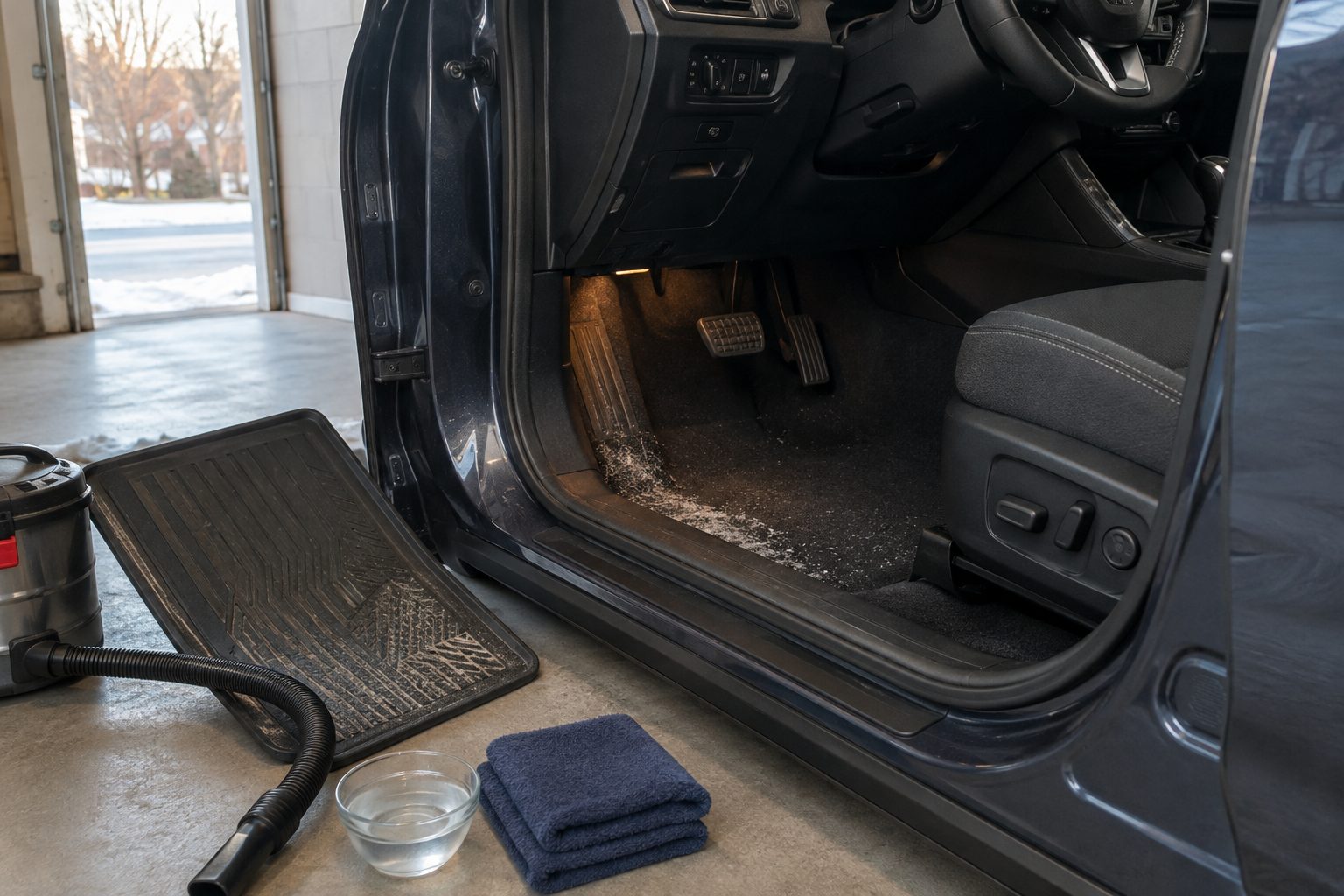
For ordinary white deicer residue tracked onto fixed car carpet, vacuum the dry crystals first. Check the vehicle maker’s interior-cleaning instructions, test a hidden spot, then use repeated small passes with a clean water-dampened cloth to dissolve and lift the residue. Blot or wet-extract immediately and dry the carpet and padding completely. Do not pour water into the footwell or improvise with vinegar, bleach, solvents, or a strong household cleaner. Stop for unknown liquid, fuel, coolant, sewage, visible growth, soaked padding, or moisture around wiring and seat electronics.
Confirm that the white residue is an ordinary salt-cleaning job
Road deicer carried in on wet shoes can dry into a white crust or ring, but appearance alone does not identify every deposit. Check when the mark appeared, whether it feels dry and crystalline, and whether the carpet has an oily feel, unusual color, strong odor, or continuing moisture. EPA identifies sodium chloride as the most common highway deicer and notes that other deicers are also used; a generic white stain is not proof of one exact chemical.
Remove the floor mat and inspect the fixed carpet, door sill, and the lowest accessible edge without forcing trim. Press a clean dry towel onto the area. If the carpet squishes, the towel picks up substantial moisture, or dampness extends under a seat or fixed console, move from spot cleaning to a wet-carpet assessment. Do not vacuum or wet-clean fuel, coolant, battery electrolyte, solvent, sewage, floodwater, street runoff, or an unidentified liquid.
If columns extend beyond the screen, scroll sideways. Keyboard: focus the table and use the left/right arrow keys.
| What you find | Start with | Do not do |
|---|---|---|
| Loose dry white crystals on fixed carpet | Dry vacuum with a suitable soft nozzle | Scrub the grit into the fibers or add liquid first |
| Dry white ring after tracked-in winter slush | Small water-dampened cloth passes followed by blotting | Pour or spray enough water to soak the backing |
| Salt on a removable carpet or all-weather mat | Remove it and use the material-specific mat process | Clean a loose driver mat in place or reinstall it damp |
| Cool-damp carpet, squishing, or moisture returning under pressure | Assess the carpet and padding as a wet assembly | Assume a dry-looking pile means the padding is dry |
| Oily, colored, strongly odorous, biological, or unknown contamination | Isolate the area and arrange substance-specific help | Vacuum, mix cleaners, or send the liquid to a household drain |
Remove dry crystals before introducing water
Let an ordinary tracked-in salt deposit dry if the carpet is otherwise dry and the vehicle can sit safely. Break only the loose surface crust with light towel pressure or a soft carpet-safe brush when the vehicle maker permits it. Vacuum slowly from several directions, keeping the nozzle clear of wiring, trim gaps, seat tracks, and loose fasteners. The goal is to remove particles before they become a salty slurry.
A household dry vacuum must not pick up liquid. A wet/dry vacuum still has to be configured for the job described in its own manual; filter and bag rules vary by model. Stop when dry passes no longer collect visible particles. Aggressive brushing is not a substitute for the controlled water step because residue held within the fibers still needs to be dissolved and transferred out.
Use measured water—not an improvised neutralizer
The practical indoor goal is dissolution and removal. Ford’s current owner guidance for carpets and floor mats starts with vacuuming, then a soft damp cloth with mild soap and water, followed by drying; it also warns against oversaturating a spot. GM guidance similarly starts carpet soil removal with plain water and a wrung, lint-free cloth before moving to a mild soap solution when needed.
That is a safer decision structure than treating vinegar, baking soda, bleach, dish detergent, or a home-mixed acid as a universal salt neutralizer. A pH reaction does not prove that dissolved residue has left the fibers or that the mixture is compatible with the carpet dye, backing, adhesive, nearby trim, wiring, or seat components. Use only a cleaner the vehicle or carpet maker permits, at the label dilution, after a hidden test.
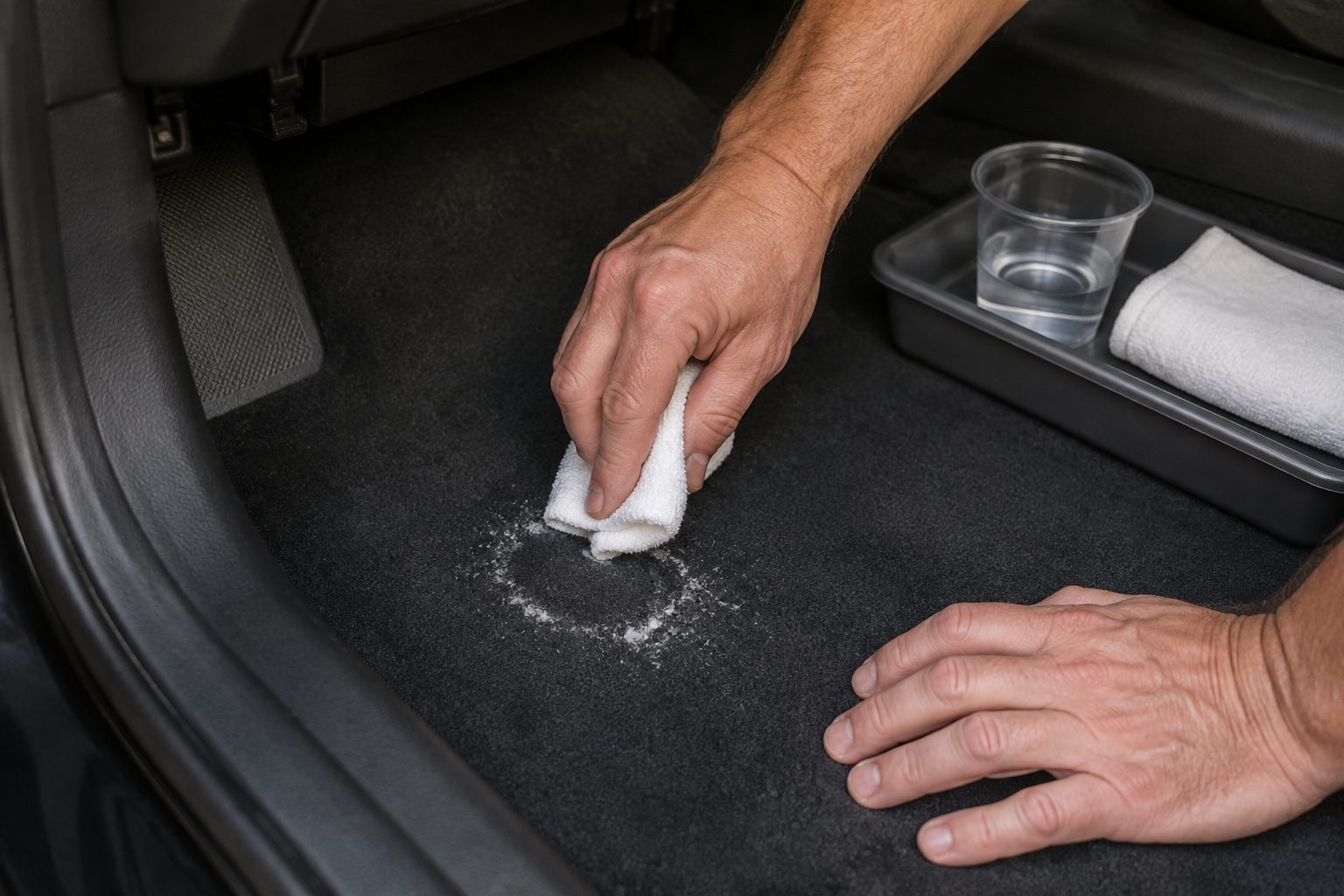
For a practical test, work a small area about 6 by 6 inches rather than the whole footwell. Put 4–8 fluid ounces of clean water in a stable cup or tray as a working supply, not as an amount to pour onto the carpet. Fold the cloth into clean faces, dampen one face, and wring it until it does not drip.
If columns extend beyond the screen, scroll sideways. Keyboard: focus the table and use the left/right arrow keys.
| Item | Pass condition | Reason |
|---|---|---|
| Hidden test area | About 6 × 6 in. with no color or texture change after drying | Find an incompatibility before expanding the work |
| Working water | 4–8 fl oz kept in a stable cup or shallow tray | Provides clean rinse water without pouring into the footwell |
| Damp cloth | Wet enough to transfer moisture but not drip when held | Keeps the water on the tool instead of in the padding |
| Dry towels | Several clean faces available for immediate pressure blotting | Each pass needs somewhere for dissolved residue and moisture to go |
Run repeated dissolve-and-lift passes
Start at the outside edge of the mark and move toward the center so the wet boundary does not keep expanding. Press and lift with the damp cloth; do not flood, grind, or scrub aggressively. Turn to a clean cloth face as soon as residue transfers. Then press a dry towel firmly onto the same small zone before repeating with fresh clean water.
Several controlled passes are more useful than one large dose because every cycle pairs a little dissolution with immediate removal. When a visible ring remains but the dry towel is becoming wetter on each pass, pause and extract or dry rather than adding more water. If plain water removes the white deposit but darker traffic soil remains, use only an OEM- or carpet-maker-approved mild product, follow its exact dilution, and perform clean-water passes afterward to remove cleaner residue.
- Dry vacuum until loose crystals stop moving
- Test a hidden area and allow it to show any color or texture change
- Dampen the cloth away from the carpet and wring it until non-dripping
- Press from the mark’s outer edge toward the center
- Blot or extract immediately after every damp pass
- Finish with clean-water passes whenever a permitted cleaner was used
Use a wet/dry vacuum only when it is truly configured for liquid pickup
A compact wet/dry vacuum with an upholstery nozzle can remove moisture after each controlled pass, but it does not authorize more water. Shop-Vac’s current guidance specifies a foam sleeve for wet pickup on applicable models; other brands and models can require a different filter arrangement. Empty dry debris, remove a disposable dry bag when the manual requires it, preserve the float assembly, and follow the exact liquid-pickup instructions for that vacuum.
Keep the machine on a dry stable surface outside the vehicle. Keep the plug, receptacle, and any approved GFCI protection away from the damp work zone, and route the hose and cord clear of doors, feet, and vehicle controls. Make slow overlapping extraction passes until the nozzle stops pulling visible droplets and a dry towel pressed onto the area remains nearly dry.
Do not use any consumer vacuum on fuel, oil, solvent, coolant, battery electrolyte, sewage, floodwater, street runoff, or unknown liquid. If moisture reached seat wiring, restraint components, control modules, or a traction-battery area, stop and follow the vehicle maker’s service guidance.
Treat removable mats and fixed carpet as two different layers
A removable mat can be carried to a tray or maker-approved wash location, cleaned on both sides, and dried away from the vehicle. Fixed carpet cannot be tipped, rinsed, or inspected as freely. Do not compensate by pouring water into the footwell, prying up trim, or removing a seat when service information and your skill level do not support the work.
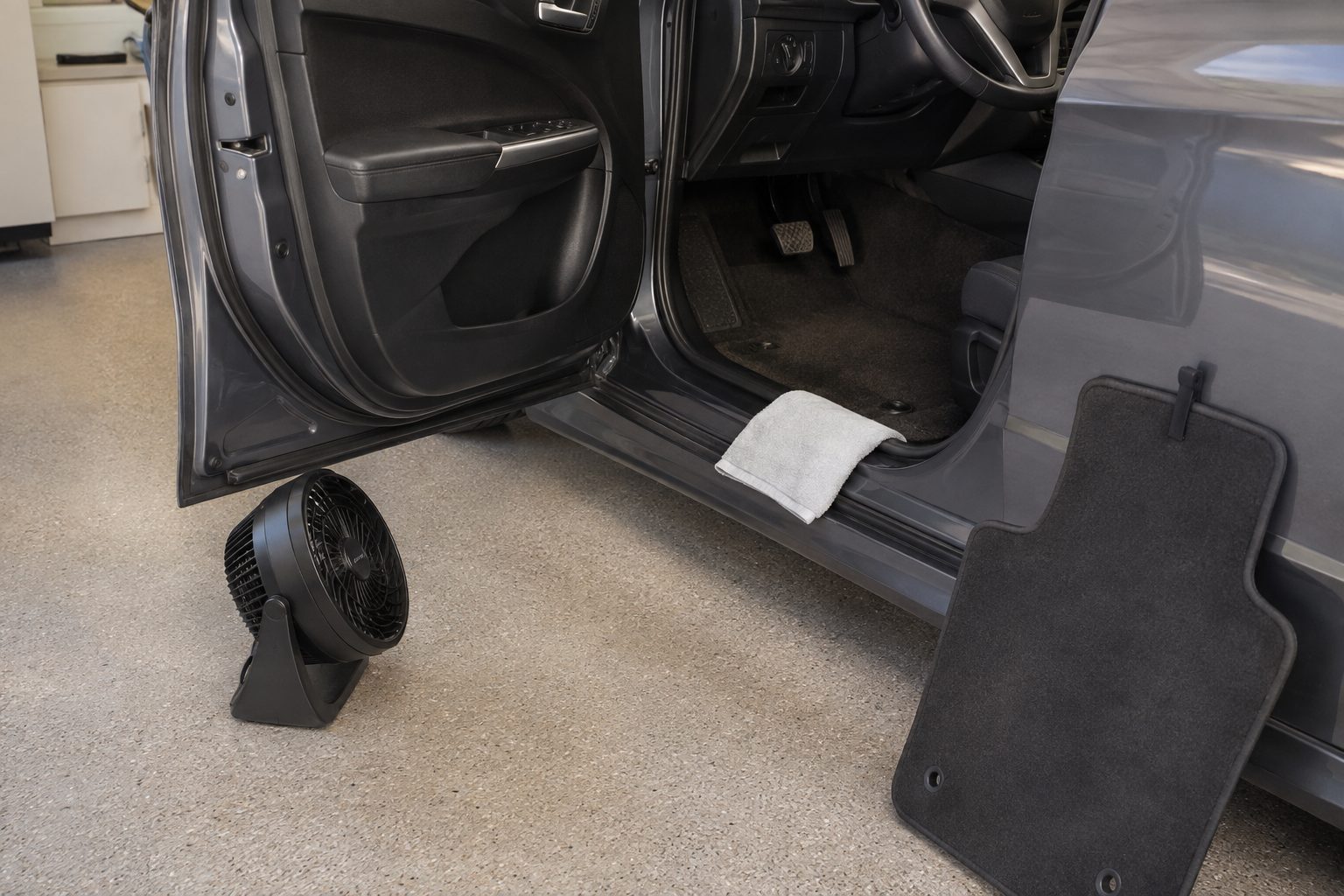
Before the mat returns, vacuum any dry residue from its underside and the floor beneath it. NHTSA warns that an incorrectly fitted or unsecured driver mat can interfere with the accelerator or brake. Reinstall exactly one completely dry, correct-size driver mat, engage every retention clip, and confirm full pedal clearance while the vehicle is parked and switched off.
Dry the carpet and verify the layer below
After the last extraction or blot, press a fresh dry white towel on several points for about 30 seconds each. Compare the cleaned area with nearby dry carpet. It should not squish, release droplets, or feel distinctly cool-damp at the lowest accessible edge. Leave the door open only in a secure dry location and use ordinary air movement across—not electrical equipment inside—the footwell. Keep the fan, cord, and connection on dry ground outside the vehicle.
EPA’s general moisture guidance for buildings recommends drying wet materials within about 24–48 hours. Treat that as urgency context, not a promise that a vehicle carpet assembly is safe after a fixed number of hours. Automotive padding, closed cavities, weather, and temperature change drying time. If moisture returns after the fan stops, the stain repeatedly wicks back, or the area develops a musty odor, inspect the padding and the water source rather than adding fragrance or cleaner.
A pale ring that reappears after drying often means dissolved residue moved with moisture toward the surface. Repeat a smaller clean-water dissolve-and-lift cycle only if the padding remains dry and the material test still passes. A darker or spreading ring can also be cleaner residue or soil; do not assume every recurrence needs a stronger product.
Know when to stop—and reduce the next salt load
Stop DIY spot cleaning for unknown contamination, visible growth, a persistent chemical odor, soaked or inaccessible padding, separated backing, dye transfer, damaged trim, or moisture around wiring and electronics. A recurring wet footwell may come from a door seal, body drain, windshield, HVAC drain, or another leak; salt removal cannot solve the source. Use a qualified detailer, restoration specialist, or vehicle service facility as the condition requires.
During salt season, knock snow from footwear before entering, empty slush from removable liners in an approved location, vacuum dry crystals before they spread, and keep one dry utility towel in the vehicle. Use only a mat made for the correct vehicle position and never stack it. These small controls reduce how much salty water reaches fixed carpet and make the next cleanup a surface job rather than a padding-drying project.
SOURCES & FURTHER READING
- U.S. EPA: common road deicers and why chloride residue should be removed rather than guessed from appearance↗
- Ford 2026 owner’s manual: vacuuming, damp mild-soap cleaning, spot treatment, and oversaturation warning↗
- GM vehicle-care guidance: plain-water first, wrung cloth, mild neutral soap, and no heavy saturation↗
- Shop-Vac official FAQ: model-appropriate filter setup for wet pickup↗
- NHTSA winter guidance: correct mat fit, retention clips, and pedal-interference risk↗
- U.S. EPA moisture guide: drying wet materials promptly and the 24–48 hour context↗
COMMON QUESTIONS
Frequently asked questions
Does vinegar neutralize road salt on car carpet?+
Do not assume it is safe or necessary. Vehicle makers generally direct owners toward vacuuming, a water-dampened cloth, and a permitted mild cleaner. Vinegar does not prove that residue has left the fibers and may be incompatible with carpet dye, backing, adhesives, trim, or nearby components.
How much water should I use on a salt stain?+
Do not pour water into the footwell. Work one small area with a damp, non-dripping cloth, then blot or wet-extract immediately. The pass is too wet if moisture spreads beyond the working zone, the carpet squishes, or a dry towel keeps pulling substantial water.
Why does the white salt ring return after the carpet dries?+
Dissolved residue can move with moisture toward the surface as the carpet dries. Repeat a smaller clean-water dissolve-and-lift pass only when the padding is dry; do not automatically add a stronger cleaner.
Can I use a shop vac on a road-salt carpet stain?+
Only use a true wet/dry vacuum configured for liquid pickup according to its own manual, and only for ordinary water-based residue. Keep electrical connections dry and never vacuum fuel, coolant, solvent, battery electrolyte, sewage, floodwater, street runoff, or unknown liquid.
Can I use dish soap or a household carpet cleaner?+
Not unless the vehicle or carpet maker permits that exact type of product. Start with clean water after dry vacuuming. If soil remains, use a compatible mild cleaner at its labeled dilution and remove the cleaner with controlled clean-water passes.
When is the car carpet dry enough?+
There is no universal number of hours. The surface and lowest accessible layer should not squish, release droplets, feel distinctly cool-damp, or transfer moisture to a fresh dry towel. Persistent moisture, odor, or a recurring wet area needs a padding and leak assessment.

We check guidance against source material, equipment instructions, and our published editorial standards. Read the policy →