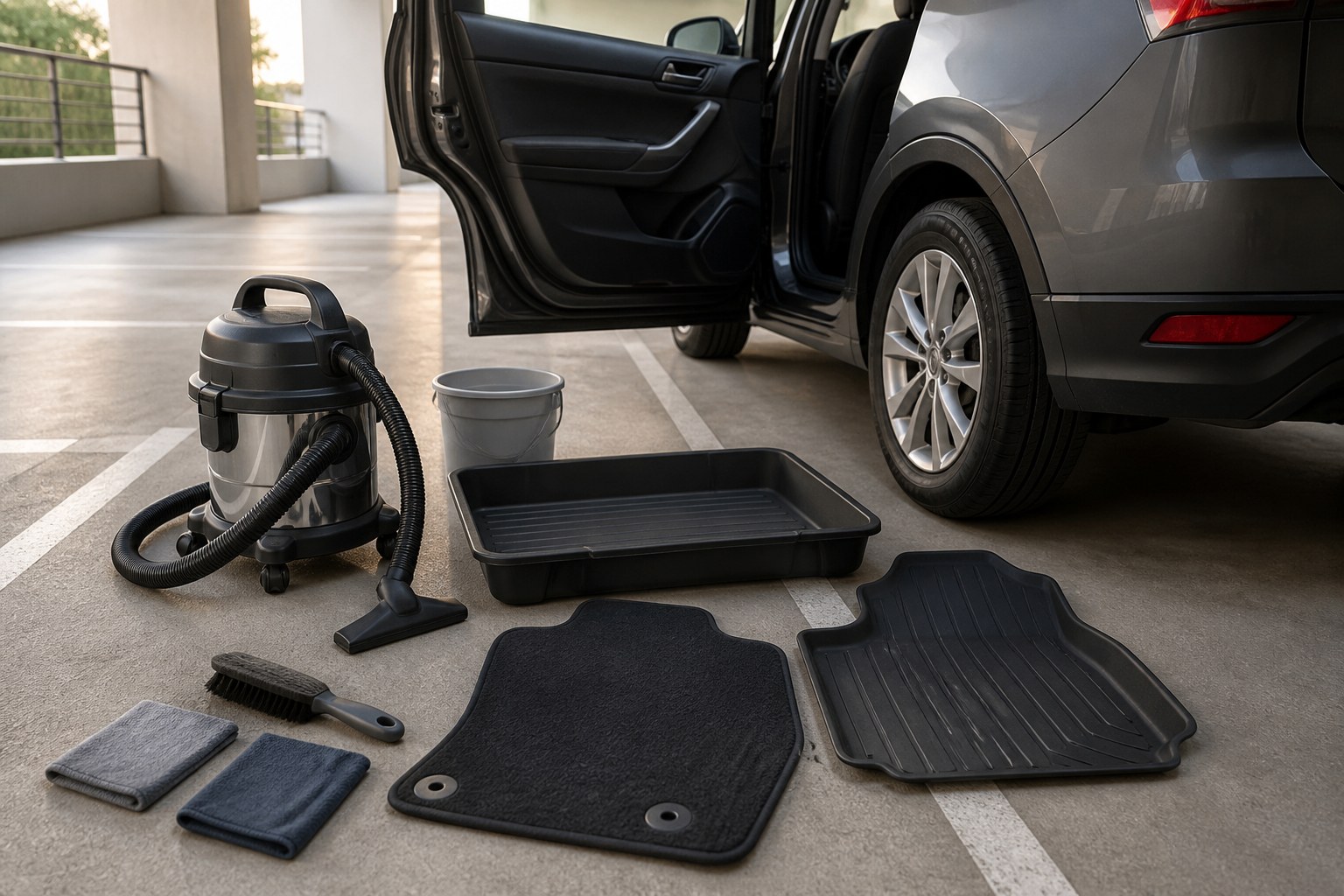
Yes. Remove the mats, check the material label, and vacuum or brush away loose grit first. For carpet mats, apply a mild soap-and-water solution to a soft damp cloth instead of pouring it onto the fibers; avoid soaking the backing. For rubber or all-weather liners, use a water-dampened cloth or soft brush and add mild soap only when needed. Wipe away residue, dry both sides completely, then reinstall one correctly sized driver mat on every factory retainer with clear pedal travel. This is a low-water method—not a promise that every dirty mat can be cleaned with no rinse at all.
Choose the path by material, soil, and available water
A no-hose cleanup works because removable mats let you control where the water goes. The goal is not to force every job into a dry wipe. It is to use the least water that can remove the soil and cleaner without saturating carpet, leaving a slippery liner, or sending dirty runoff across a parking lot.
Start with the label on the mat and the vehicle owner’s manual. Carpet, rubber, thermoplastic elastomer, vinyl, and brand-specific liner compounds are not interchangeable. Ford’s current owner guidance, for example, separates carpet cleaning from rubber-mat cleaning and says mats should be completely dry before they are reinstalled. Treat that as a useful manufacturer example, then follow the instructions for your exact vehicle and mats.
If columns extend beyond the screen, scroll sideways. Keyboard: focus the table and use the left/right arrow keys.
| Mat and condition | First method | Water-control rule | When to change plans |
|---|---|---|---|
| Carpet: dry dust, sand, hair | Vacuum, brush, vacuum again | Use no water unless residue remains | Stop if the backing or edge is already damaged |
| Carpet: light footprints or a small compatible stain | Soft damp cloth with label-approved mild solution | Put solution on the cloth, not directly on the mat | Stop for color transfer, backing separation, or a label that prohibits wet cleaning |
| Carpet: broad traffic film | Work the affected face in small sections | Use repeated damp-cloth passes; do not soak the backing | Use a professional or approved deeper method if complete drying is uncertain |
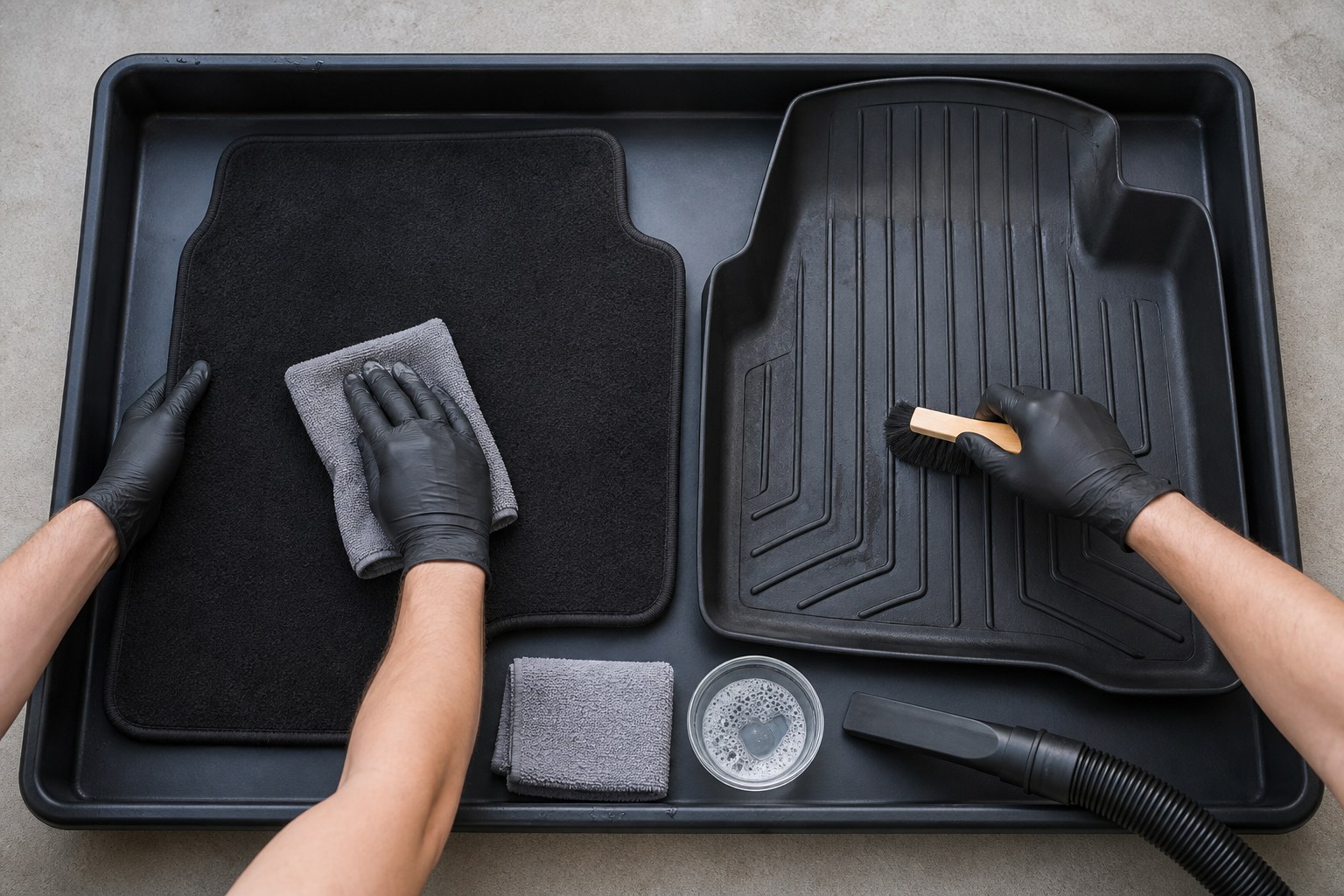
| Rubber or all-weather: dust and light mud | Water-dampened cloth or soft brush | Work inside a shallow tray and collect every drip | Check the maker’s instructions if the material is unknown or tacky |
| Rubber or all-weather: salt crust or heavy mud | Mild soap solution and soft brush | Remove loosened soil with clean damp towels | Move to a controlled rinse only when residue will not wipe away |
| Oil, fuel, coolant, battery fluid, sewage, or unknown liquid | Do not use the routine mat method | Isolate the mat and keep the liquid out of drains | Use the label, vehicle maker, local HHW program, or a qualified professional |
Build a contained apartment-friendly work area
Ask the property manager before working in a shared garage, utility room, balcony, or parking space. A removable mat is smaller than a vehicle, but a lease can still restrict cleaning, wastewater, or objects left to dry. Choose a ventilated place where the mat can lie flat, people will not trip over it, and dirty liquid cannot reach a storm drain.
Use a shallow waterproof tray or tote whose footprint is larger than the mat. A rim of roughly 2 inches is a practical containment feature, not a government standard; the tray does not need to be filled. Add a compact vacuum approved for the material being collected, a soft brush, several utility microfiber towels, a small mixing container, dry towels, and gloves when the product label calls for them. Keep clean and dirty towels separate.
EPA’s general vehicle-washing guidance says to minimize water and soap, wring rags over a bucket or sink, and keep wash water out of storm drains. Apply that here as a containment principle, not as permission to pour every kind of dirty mat water into a household drain. Ordinary soil-and-soap water, automotive fluids, and unknown contamination have different disposal rules. Check the cleaner label, lease, and local sewer or household hazardous-waste guidance.
- One tray wider and longer than the mat
- One soft brush reserved for dirty interior work
- At least two damp utility towels plus dry absorbent towels
- A small container mixed exactly to the product label
- A ventilated drying location where both sides can receive airflow
Remove dry soil before adding moisture
Photograph or note the driver-mat orientation and every retention point before removal. With the vehicle parked and switched off, lift each mat without spilling collected grit into the footwell. Shake it only where dust is permitted and contained. If outdoor shaking would spread debris, carry the mat directly to the tray and vacuum it there.
Vacuum both faces, the edges, retention holes, grooves, and the underside. On carpet, use a soft brush to lift compacted dry soil, then vacuum again. On molded liners, tip loose debris toward the vacuum nozzle rather than chasing it with a wet cloth. Dry removal prevents sand and salt crystals from becoming an abrasive slurry and often turns a planned wet wash into a small spot-cleaning job.
Do not use a dry household vacuum for liquid or unknown material. If a mat is already wet with clean water and the fixed carpet underneath is damp, move to a true wet/dry-vac assessment. Floodwater, sewage, fuel, coolant, battery electrolyte, solvent, and unidentified liquid are outside this guide.
Clean carpet mats without saturating the backing
Read the sewn label or manufacturer instructions before using moisture. Test the prepared solution on an inconspicuous area about 6 inches square and let the spot dry enough to check for color transfer, a texture change, or adhesive failure. Do not assume a household recipe, dish soap, steam cleaner, washing machine, or extractor is safe for every carpet face and backing.
For compatible mats, fold a soft cloth into clean faces, dampen it with the label-approved mild soap-and-water solution, and wring it over the container. Blot and wipe a small section using light pressure. Put water on the tool rather than pouring it onto the mat. Turn to a clean cloth face as soil transfers. Ford advises avoiding excessive wetting of carpet and treating the affected area when spot cleaning could leave a ring; the practical lesson is controlled, even coverage—not repeated soaking of one dark spot.
Follow with a separate cloth dampened in clean water to pick up loosened soil and cleaner. Repeat with freshly rinsed cloth faces until they no longer feel slick or produce visible foam. Press dry towels into the face and backing. If the mat stays heavily soiled, develops a water ring, transfers dye, smells musty, or cannot be dried completely in your space, stop rather than adding more liquid.
Clean rubber and all-weather liners without making them slippery
Start with a water-dampened soft cloth or brush inside the tray. Work along channels and raised edges, then lift the dirty liquid with a utility towel. Add a mild, material-compatible soap solution only where plain water and agitation are not enough. Manufacturer guidance varies, so do not treat rubber, TPE, PVC, vinyl, and proprietary liner compounds as one material.
GM owner guidance warns against silicone-, wax-, and gloss-enhancing products on rubber or all-weather mats because the surface can become slippery. That rules out tire shine, dashboard dressing, and glossy protectants as finishing products for the driver’s mat. A shiny appearance is not a useful cleaning target; a residue-free, non-slippery surface is.
For winter salt, loosen dry crystals first, then use repeated damp passes so dissolved salt leaves with the towel. If channels still hold foam, an oily film remains, or salt continues to reappear after drying, the job needs more complete residue removal. Move the liner to a bathtub, utility sink, self-service wash, or another maker-approved controlled-rinse location only when the lease, local rules, mat instructions, and wastewater route allow it. Capture solids before they enter a drain.
If columns extend beyond the screen, scroll sideways. Keyboard: focus the table and use the left/right arrow keys.
| What you observe | Likely problem | Next action |
|---|---|---|
| Surface feels slick after wiping | Cleaner or dressing remains | Use clean damp towels until the slick feel is gone; do not reinstall |
| White film returns after the face dries | Salt or cleaner remains in channels | Repeat controlled damp passes or use an approved contained rinse |
| Mat becomes tacky, soft, cracked, or discolored | Cleaner may be incompatible or the material may be deteriorating | Stop and consult the mat maker; replacement may be safer |
| Unknown oily liquid is present | Routine soap cleanup may spread automotive contamination | Isolate it and use product-specific and local disposal guidance |
Remove residue and dry both sides completely
A no-hose method succeeds only if the cleaner leaves with the towels. Use a second container of clean water or a clean damp towel for the final passes, and replace the water when it becomes visibly dirty. Do not hide residue with fragrance or protectant. On carpet, press rather than scrub during the final pass so you can see whether foam or soil still transfers. On a molded liner, inspect grooves, retaining holes, edges, and the textured heel area.
Blot with dry towels, then stand or support the mat so air can reach the face, edges, retention holes, and backing. Use normal ventilation in a secure dry space; follow any fan or dehumidifier instructions and keep electrical equipment away from water. Do not publish a fixed two-hour or overnight promise: drying time changes with material thickness, backing, temperature, humidity, and how much water was used.
Check with your hands and a fresh dry towel. Carpet backing should not feel cool-damp or transfer moisture under firm pressure. An all-weather liner should have no water trapped in channels or beneath edge lips. Ford’s manual example says mats should be completely dry before reinstallation. If the vehicle must be driven first, leave the wet mat out rather than installing it damp or loose.
Reinstall one dry driver mat and verify every pedal
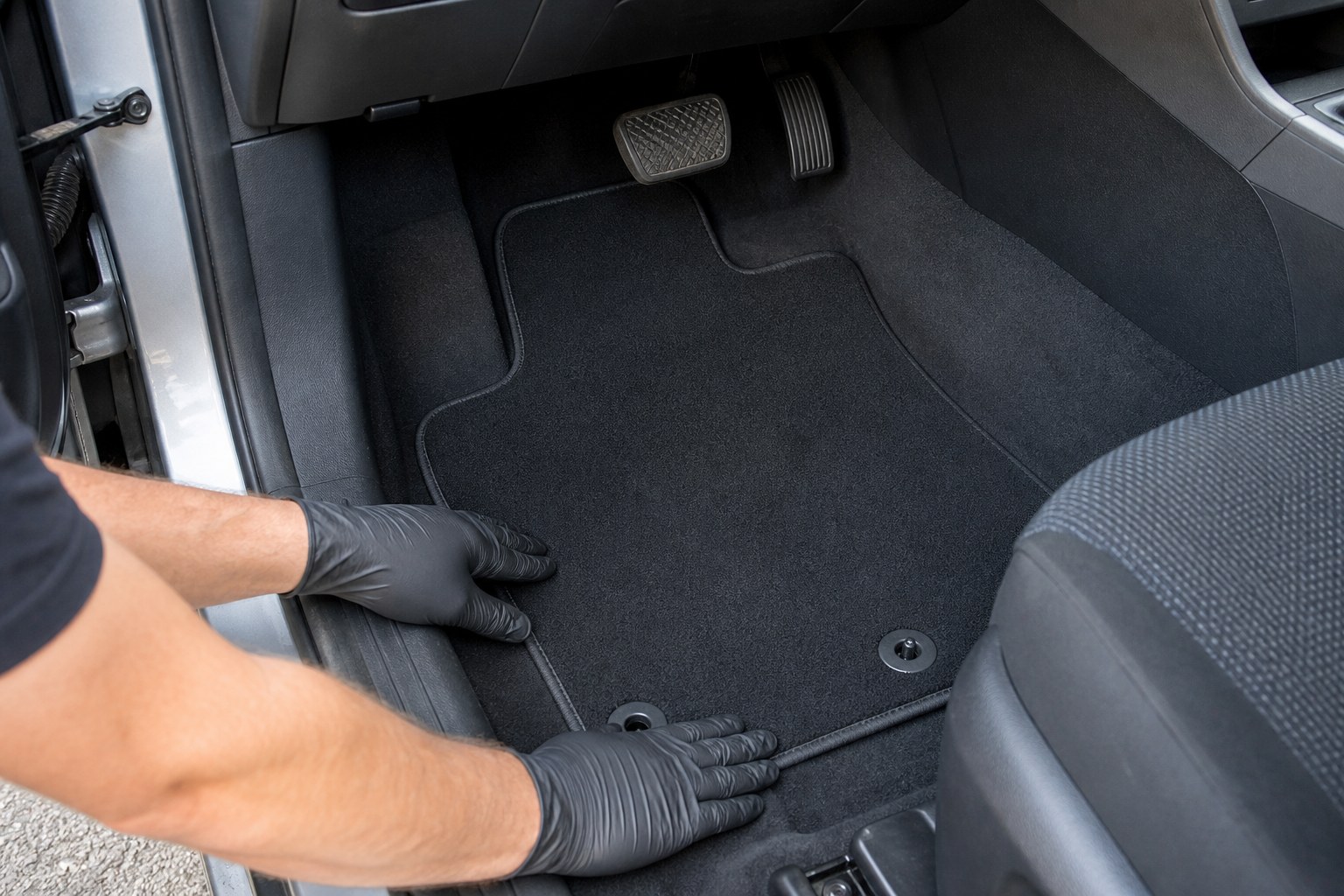
The final step is a vehicle-control check, not decoration. NHTSA warns that an improperly installed floor mat can interfere with the accelerator or brake. Use a mat made for the correct vehicle position and model, place it directly on the vehicle floor, engage every factory retention clip or post, and never stack it over another mat. Do not flip a carpet mat over or put a loose liner beneath it.
With the vehicle still parked and switched off, press around the perimeter and pull gently rearward to confirm the retainers are engaged. Visually inspect the gap to the accelerator, brake, and clutch when fitted. Then press each pedal through its full normal travel by hand or as the vehicle manual directs and confirm that no mat edge, curled corner, or raised channel can touch it. If the correct fit or retention cannot be confirmed, remove the mat and use the manufacturer’s replacement guidance.
Repeat the inspection whenever mats are removed, after a car wash or service visit, and when switching to heavy winter liners. A clean mat is not safe merely because it looks new. Correct size, one layer, complete drying, secure retainers, and clear pedal travel are the pass conditions.
- Correct mat in the correct seating position
- Exactly one driver mat—never stacked
- Every factory retainer fully engaged
- No curled edge or raised channel near a pedal
- Full accelerator, brake, and clutch clearance verified while parked
Know which jobs are not routine floor-mat cleaning
Stop DIY cleaning for fuel, oil, solvent, coolant, battery electrolyte, sewage, floodwater, unknown liquid, visible mold, strong chemical odor, or a mat whose layers are separating. Do not vacuum unknown liquid, mix cleaners, or call appearance cleaning disinfection. EPA and CPSC both emphasize label directions and ventilation; EPA also notes that “natural” does not automatically mean safer and warns that incompatible cleaners can create toxic gases.
Keep contaminated liquid out of the storm drain, ground, and ordinary household drain until the substance and local disposal route are known. Contact the mat or vehicle maker, local sewer authority, household hazardous-waste program, insurer, or a qualified restoration professional as the situation requires. Replacement is often the safer choice when a driver mat cannot be made residue-free, flat, securely retained, and fully dry.
For ordinary dirt, the useful routine is simple: identify the material, remove dry debris, meter water through the tool, capture the residue, dry every layer, and reinstall safely. That is more repeatable in an apartment than carrying a dripping mat through the building or improvising with a hose where one is not allowed.
SOURCES & FURTHER READING
- Ford 2025 Explorer owner’s manual: carpet and rubber-mat cleaning and complete drying↗
- GM 2025 Buick Enclave owner’s manual: all-weather mat cleaning and slippery-product warning↗
- NHTSA: correct floor-mat fit, manufacturer instructions, and retention clips↗
- WeatherTech official liner instructions: removal, mild cleaner, water, retainers, and pedal clearance↗
- U.S. EPA: minimizing car-wash water, capturing rag water, and avoiding storm drains↗
- U.S. EPA stormwater BMP: detergent limits and vehicle-wash wastewater risks↗
- U.S. EPA Safer Choice FAQ: label use, “natural” claims, and dangerous cleaner mixtures↗
- CPSC indoor-air guide: ventilation and household-product label directions↗
COMMON QUESTIONS
Frequently asked questions
Can I clean carpet car mats without a hose?+
Yes, when the mat label permits damp cleaning. Vacuum first, put a mild label-approved solution on a soft damp cloth, avoid soaking the backing, remove residue with a clean damp cloth, and dry both sides completely.
How do I clean rubber car mats without a hose?+
Remove dry debris, then use a water-dampened cloth or soft brush inside a shallow tray. Add mild compatible soap only when needed and keep wiping with clean damp towels until no slick or foamy residue remains.
Can I use tire shine on all-weather floor mats?+
No. GM warns against silicone-, wax-, and gloss-enhancing products because they can make rubber or all-weather mats slippery. Use only products approved by the mat maker and leave the driver’s mat residue-free.
How long should car floor mats dry?+
There is no universal number. Material, backing, temperature, humidity, airflow, and water amount all change drying time. Reinstall only when the face, edges, retention holes, and backing are completely dry.
Can I stack an all-weather mat over a carpet mat?+
No. NHTSA advises using the correct-size mat and the vehicle’s retention clips. Install one driver mat directly on the floor and confirm it cannot interfere with the accelerator, brake, or clutch.
Where should apartment residents dispose of dirty mat water?+
Keep it out of parking-lot storm drains. Follow the cleaner label, lease, and local sewer or household hazardous-waste rules. Do not put automotive fluids or unknown contamination into a sink, toilet, storm drain, or onto the ground.

We check guidance against source material, equipment instructions, and our published editorial standards. Read the policy →