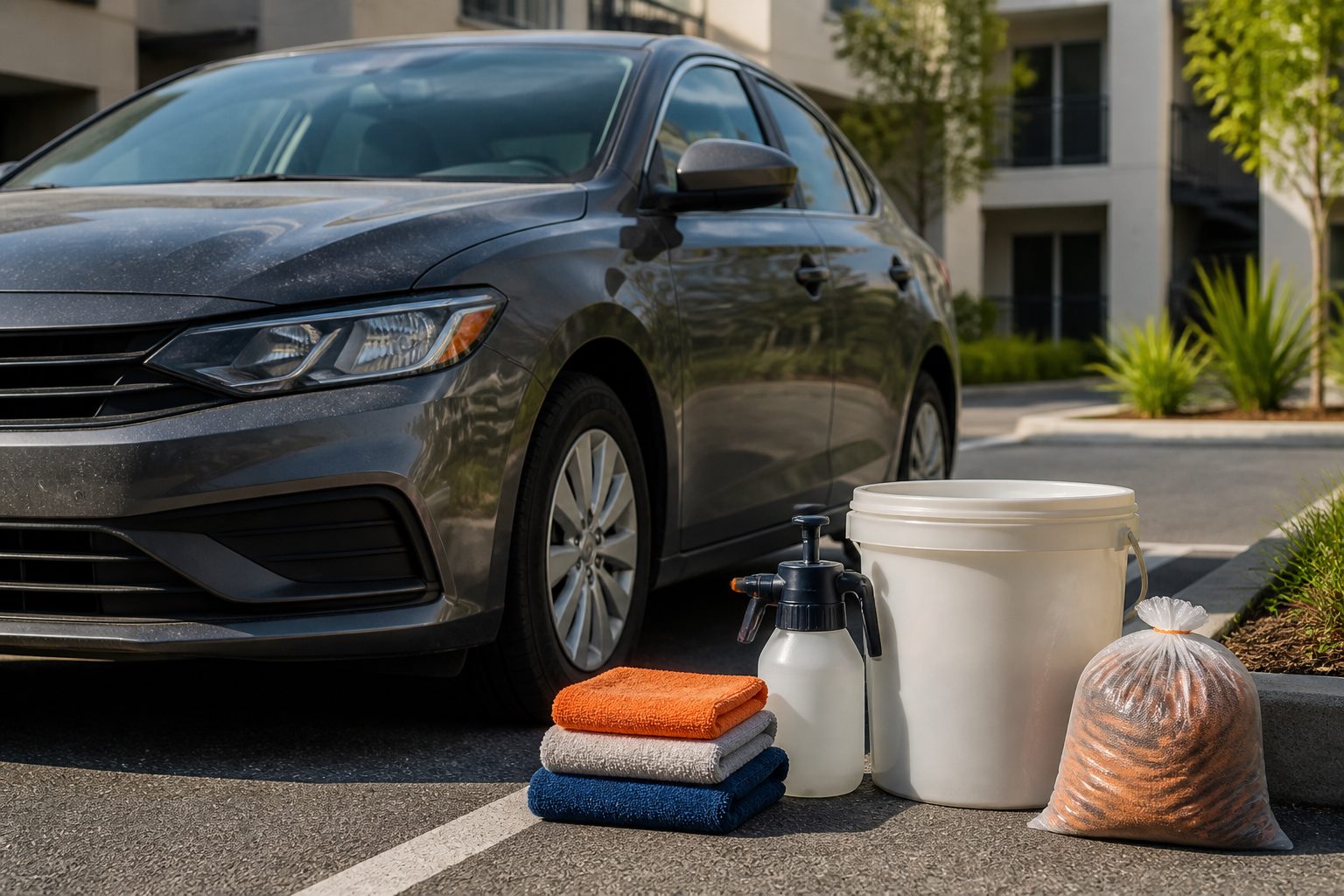
You can wash a lightly dirty car without a hose at an apartment when the property permits it and you have an approved way to contain and dispose of wash water. Use a purpose-made rinseless product at its labeled dilution, several clean microfiber towels, and one small section at a time. Use a waterless product only within its stated soil and surface limits. Choose a commercial wash for caked mud, gritty salt, or a parking area where washing or runoff cannot be managed; have unknown contamination assessed before cleaning.
Check the parking space before choosing supplies
Ask management whether exterior washing is permitted, which space you may use, where water may be obtained, and how used solution must be removed. Check local stormwater and water-use rules as well. A product advertised for apartments does not establish permission to wash in your assigned space.
Walk the route from the apartment to the car. Identify stairs, sloped pavement, drains, neighboring vehicles, and the space needed to open doors and carry equipment. Keep the working area inside the approved space and out of pedestrian and accessible routes. If you cannot keep drips from reaching a drain or another space, use the designated wash bay or a commercial facility.
- Permission for the specific location and method
- A manageable route for clean supplies and dirty-water containers
- Room to work without spraying a neighbor or blocking a path
- An approved disposal destination before the first wash pass
Choose rinseless, waterless, or an off-site wash
Rinseless washing uses a product intended to clean without a final hose rinse, commonly mixed into a bucket of water. Waterless washing uses a purpose-made spray-and-wipe product without a wash bucket. The terms describe the process, not a guarantee of zero drips or scratch-free contact. Ordinary rinse-off shampoo does not become rinseless by using less of it.
Our conservative starting point for shared parking is light dust or light traffic film on a compatible, intact finish. Inspect lower doors, rocker panels, and wheel arches separately: clean-looking upper panels can hide a much heavier load below. A manufacturer may allow more contamination with a pre-rinse, but that option is not available at a hose-free parking space.
If columns extend beyond the screen, scroll sideways. Keyboard: focus the table and use the left/right arrow keys.
| Condition or constraint | Practical path | Reason to change plans |
|---|---|---|
| Light dust or light road film; washing is allowed | Label-diluted rinseless wash with clean towels | Stop if the towel picks up coarse particles or begins dragging |
| A small lightly dirty area; no bucket available | Compatible waterless product within its label limits | Do not stretch a small spray supply across heavy dirt |
| Caked mud, sand, or gritty road salt | Approved self-service or commercial pre-rinse and wash | A wet towel cannot flush packed material out of seams |
| Washing prohibited or wastewater cannot be contained | Commercial wash or the property's designated wash area | Less water does not override the location's restrictions |
| Unknown spill, oily contamination, or damaged finish | Vehicle-specific advice or professional assessment | Do not start with a stronger home-mixed cleaner |
Measure dilution and carrying weight separately
Read the directions on the exact bottle. As one documented example, Optimum No Rinse Wash & Shine V6 specifies 1 US fluid ounce of concentrate per 2 US gallons of water for a rinseless wash. Other products, versions, and uses can require different concentrations. The table scales only that example; it is not a universal recipe or a product ranking.
Calculate concentrate as water volume multiplied by the label's dose per gallon. For this example, 1 fl oz ÷ 2 gal = 0.5 fl oz per gallon. A fluid ounce measures volume, not weight; use a marked measure rather than an unmarked cap. If the label specifies a final-solution volume instead of an amount of water to add, follow that wording.
If columns extend beyond the screen, scroll sideways. Keyboard: focus the table and use the left/right arrow keys.
| Water added | ONR V6 example concentrate | Water weight before equipment |
|---|---|---|
| 1 US gal | 0.5 US fl oz | About 8.3 lb |
| 2 US gal | 1 US fl oz | About 16.7 lb |
| 5 US gal | 2.5 US fl oz | About 41.7 lb |
Pack clean supplies and a separate dirty return
For a first small-car session, six to ten clean paint-safe wash towels and two drying towels are an editorial planning allowance, not a promise that they will finish every vehicle. Bring more for a large vehicle or stop when clean faces run out. A lidded bucket with headroom, a compatible labeled sprayer if permitted by the product directions, and a separate leak-resistant used-towel container make the route easier to manage.
Keep dry towels and bottles in a clean tote rather than floating them in wash solution. Choose separate trips or a suitable cart if the full load is awkward; a one-trip kit is useful only when you can carry it safely. Keep caps closed during transport, protect labels, and avoid beverage containers. Plan capacity for leftover solution as well as damp towels coming back indoors.
Wash one small section and keep dirty towels out
Work on cool panels in shade where possible; Meguiar's wash guidance identifies this as a way to help prevent water spots. Check the finish and product compatibility first, particularly for matte paint, wraps, protective film, or damaged clear coat. Start on a small inconspicuous section. Follow any pre-spray directions for that product without letting overspray drift onto neighboring property.
Load a clean wash towel with the measured solution. Fold it to expose a fresh face, make short gentle passes, and turn to a clean face when it collects soil. Dry the section using the product's instructions before moving on. Work from cleaner upper panels toward dirtier lower panels and keep wheel tools separate. Follow label precautions for skin and eye exposure.
In this many-towel workflow, place used towels in the return container instead of dipping them back into clean solution. A dropped towel goes into that container immediately. If all faces are dirty, use another towel. Do not press harder, reuse a contaminated face, or continue across a gritty panel to meet a towel or water target.
Finish with the disposal route you confirmed
Keep used wash water out of storm drains. EPA recommends commercial washes and gives household options for limiting runoff and disposing of ordinary wash water. King County's current residential guidance also directs residents to keep dirty bucket water off driveways, sidewalks, and streets. Those sources do not establish permission to empty a bucket onto apartment landscaping or into an unidentified garage drain.
Before using a sink or toilet, confirm with management or the wastewater utility that the specific ordinary wash solution is accepted and the fixture reaches an appropriate sanitary system. Do not assume a floor drain connects to it, or that a septic system has the same acceptance rules. Follow product instructions and local requirements; if the route is uncertain, keep the container closed and obtain guidance before washing.
Automotive fluids or unknown hazardous contamination need separate handling. Do not mix them with wash water or send them down a household drain. Once the normal wash is finished, carry away the leftover solution, collect supplies, check for drips, and clean and dry towels according to their care instructions. A wet towel container is for transport, not long-term storage.
Use a stopping rule when conditions change
If solution dries before you can finish a section, reduce the working area and move to cooler conditions. ONR V6 directions call for rewashing a dried section and drying it again; other products may differ. Do not buff a dry, still-dirty film with extra pressure. A recurring streak can reflect contamination, an incorrect mix, a loaded towel, or conditions outside the product's directions.
Stop if wind is depositing grit or carrying spray beyond the space, freezing conditions could make pavement slippery, runoff escapes the work area, or you run out of clean towels. Put the kit away or use a suitable wash facility. On the next permitted wash, adjust the towel count, carried water, and section size from what you actually needed rather than assuming a fixed kit suits every car.
SOURCES & FURTHER READING
- U.S. EPA: household car washing, runoff, and ordinary wash-water disposal↗
- Optimum No Rinse Wash & Shine V6: exact wash dilution and section-by-section directions↗
- USGS: approximate water weight of 8.34 pounds per US gallon↗
- King County: current residential car-wash and dirty-water guidance↗
- Meguiar's FAQ: cool surfaces and shade when washing and drying↗
- U.S. EPA: household hazardous products and local disposal guidance↗
COMMON QUESTIONS
Frequently asked questions
Can I wash my car in an apartment parking lot?+
Only if the property and local rules allow it. Ask management first; some communities provide a designated wash area or prohibit all washing in parking spaces.
How much water do I need to wash a car without a hose?+
There is no universal amount. Measure the chosen product's label dilution and carry enough for clean wash media and any permitted pre-spray. Two US gallons weigh about 16.7 lb before equipment; car size, soil, towel use, and technique determine whether that supply is sufficient.
Can I use regular car shampoo as a rinseless wash?+
Only if the exact product explicitly provides rinseless directions. Ordinary rinse-off shampoo needs its specified rinse. A lower dose does not make it suitable for wiping and drying without one.
Will a rinseless wash scratch paint?+
No contact method is guaranteed scratch-free. Follow the product's soil and surface limits, use clean towels and light pressure, and choose an approved pre-rinse for caked mud, sand, or gritty salt. Stop when a towel drags or collects coarse particles.
What should I do with used wash solution?+
Keep it out of storm drains and confirm an approved disposal route before washing. For ordinary wash water, ask management or the local wastewater utility whether an appropriate sanitary fixture accepts the solution. Automotive fluids, unknown contamination, and septic systems require separate guidance.
Does waterless mean I can wash anywhere?+
No. Waterless describes a product's cleaning process, not property permission, a wastewater exemption, or suitability for every dirt level. Follow the label, property rules, and local requirements, and contain any drips.

We check guidance against source material, equipment instructions, and our published editorial standards. Read the policy →