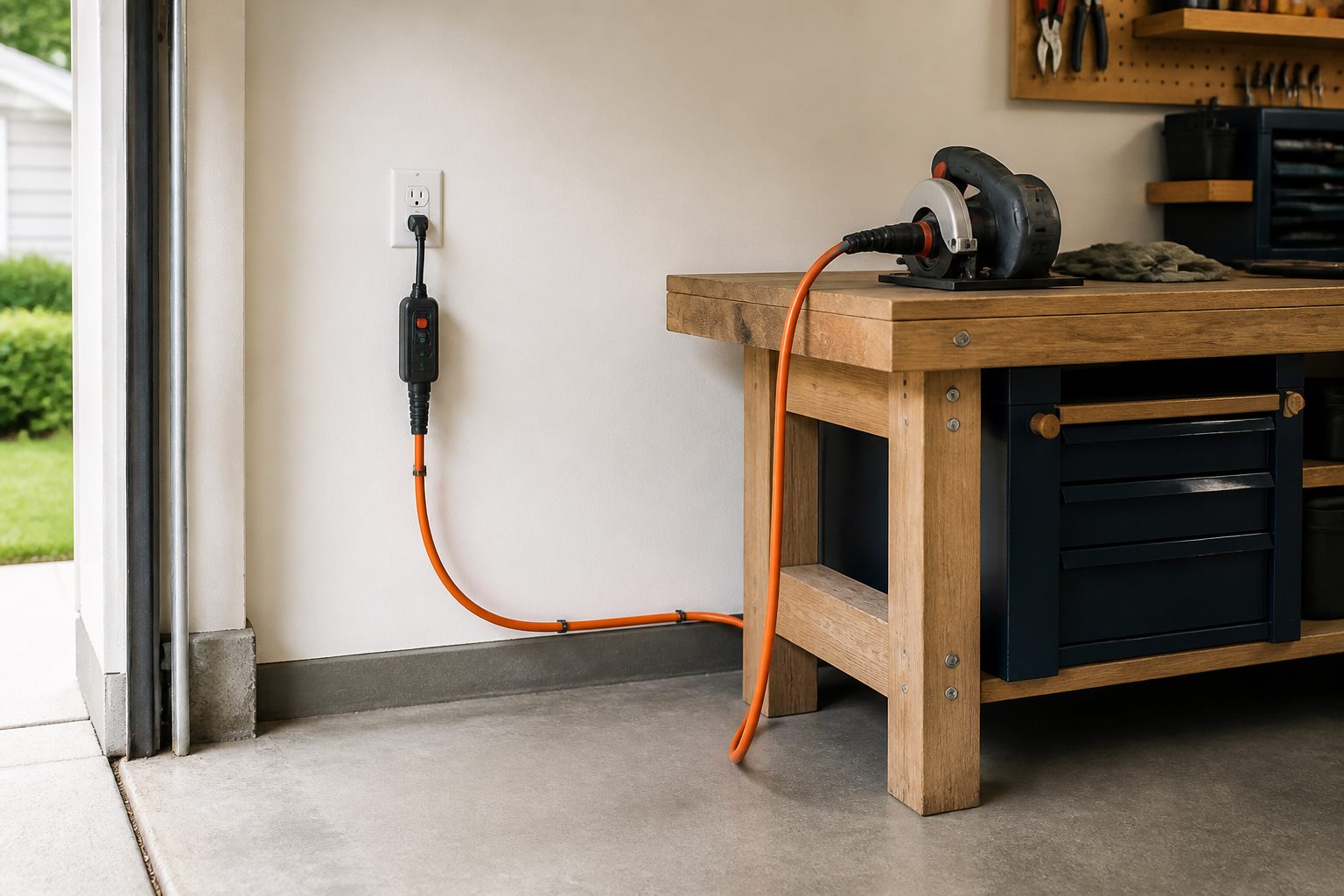
Read the tool nameplate and manual, then choose the shortest grounded three-wire cord whose marked amp or watt rating covers the load at that length and whose jacket is approved for the location. Use required GFCI protection, keep every connection dry and visible, fully inspect the cord, and never use an extension cord as permanent wiring.
An extension cord is a temporary power path
The cord is part of the electrical system while the tool is running. An undersized, damaged, wet, or tightly coiled cord can overheat or expose energized conductors. Garage use adds abrasion, vehicle traffic, sharp bench edges, metal tools, and occasional moisture, so a cord that seems adequate in a living room may be a poor fit near a driveway or work area.
Use an extension cord only when the equipment manufacturer permits it and only for temporary tasks. If a tool routinely needs power in the same location, a qualified electrician can evaluate a permanent receptacle. Do not route a cord through walls, ceilings, doorways, or under rugs, and do not defeat a grounding pin to fit an older outlet.
Start with the tool nameplate and manual
Find the input amps or watts, voltage, grounding requirements, and any extension-cord table in the manual. Use the running input rating rather than a marketing claim about motor output. Tools with motors can draw more current during startup, and some heaters, compressors, pressure washers, chargers, and welders have specific restrictions that a generic chart cannot override.
Next, read the cord markings and packaging. Confirm the cord’s electrical rating, conductor count, jacket designation, temperature and wet-location approvals, and maximum connected load. OSHA’s flexible-cord guidance for workplaces emphasizes three-wire grounded cords and jackets suitable for hard or extra-hard use; for a home garage, those are useful selection principles alongside product instructions and local electrical requirements.
Gauge and length work together
American Wire Gauge can be counterintuitive: a lower AWG number indicates a thicker conductor. Thicker conductors generally carry a given load with less voltage drop and heat, but gauge alone is not a complete recommendation. Conductor material, cord length, temperature rating, bundling, connectors, tool behavior, and the manufacturer’s instructions all affect safe use.
Measure the actual route and buy the shortest cord that reaches without tension. As length increases, the tool manufacturer may require a heavier gauge. Do not join two short cords to create a long one; the extra connection adds resistance, can separate, and is easier to expose to water. Never assume that a heavy-looking jacket means the conductors inside are suitable for a high-current tool.
- Lower AWG number means a thicker conductor
- Longer runs may require heavier conductors
- The cord’s marked rating must cover the connected load
- One correctly sized cord is better than a daisy chain
Control water, connectors, and trip paths
Keep plug-and-socket connections dry, intact, off wet floors, and out of vehicle paths. OSHA warns that wet cord connectors can leak current to the grounding conductor and expose anyone touching a metal tool or enclosure. A plastic bag or improvised tape wrap is not an approved weatherproof connection; use equipment and connection covers specifically rated for the conditions.
Use GFCI protection wherever the equipment instructions, applicable code, or location require it, especially around damp or outdoor work. Test the device as instructed before use. Route the cord along a wall or protected edge where it remains visible, add an approved cord cover across unavoidable walkways, and keep it away from heat, blades, chemicals, and moving garage-door hardware.
Inspect before use and store without damage
Before every setup, unplug the cord and inspect both faces of each connector, the grounding pin, strain reliefs, and the full jacket. Remove the cord from service if it has cuts, crushed sections, exposed conductors, scorch marks, loose blades, damaged pins, or intermittent power. A taped field repair is not equivalent to a cord restored by a qualified person using an approved method.
Uncoil the cord for inspection and follow the reel manufacturer’s load instructions; a loaded cord left tightly wound can retain heat. After use, disconnect by gripping the plug rather than pulling the cable, wipe away dry dirt, allow moisture to evaporate, and coil it in broad loops. Store it away from sunlight, sharp hooks, fuel, and the floor where a tire can crush it.
SOURCES & FURTHER READING
COMMON QUESTIONS
Frequently asked questions
Is a 12-gauge cord always better than a 14-gauge cord?+
A 12-gauge conductor is thicker, but safe selection still depends on the tool load, cord length, cord rating, environment, and manufacturer instructions. Buy the required capacity, not a gauge number in isolation.
Can I run a high-load tool while the cord is on a reel?+
Follow the reel’s marked wound and unwound load ratings. A loaded cord can retain heat when tightly coiled, so many products require full unwinding for higher loads.
Does an outdoor extension cord make any setup safe in a garage?+
No. The cord and every connector, GFCI, tool, and cover must be approved for the actual conditions, and the electrical load still has to be within the marked ratings.

We check guidance against source material, equipment instructions, and our published editorial standards. Read the policy →