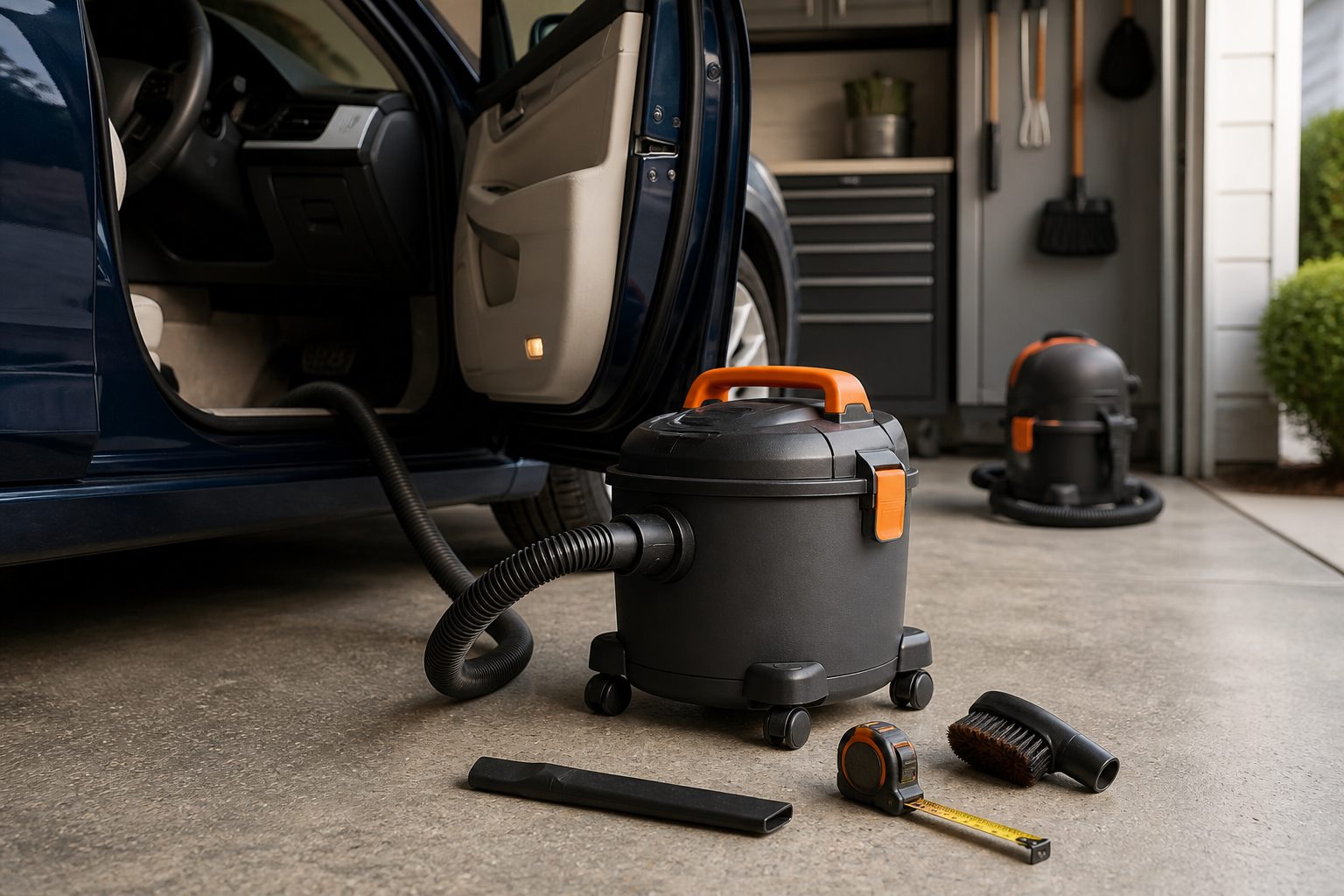
For most one- or two-car households, start with a 4–6 gallon wet/dry vacuum. That size is usually stable enough for garage use but still easy to store and move around a vehicle. Choose 1–3 gallons when apartment storage and quick dry pickups matter most; consider 8–12 gallons only when the same vacuum must also serve a workshop, several vehicles, or repeated liquid pickup. Tank size is not a suction rating, so confirm hose reach, CFM, sealed lift, filtration, cord or battery limits, and the exact wet-pickup instructions before buying.
Choose the size tier from the jobs you actually repeat
Start with the material and frequency, not the biggest number on the drum. Routine crumbs, sand, pet hair, and dry carpet debris require less collection capacity than repeated water pickup or a garage that also produces sawdust and workshop debris. A household that details one car monthly has a different bottleneck from a mobile user carrying equipment up apartment stairs.
The table below is a use-case starting point, not a performance guarantee. Two vacuums with the same gallon rating can have different airflow, sealed lift, hose diameter, filter area, noise, weight, and stability. Follow the specifications and manual for the exact model rather than assuming every machine in a tier behaves alike.
If columns extend beyond the screen, scroll sideways. Keyboard: focus the table and use the left/right arrow keys.
| Nominal drum size | Best fit | Main advantage | Main tradeoff |
|---|---|---|---|
| 1–3 gallons | Apartment storage, stairs, quick dry interior resets | Easy to carry and store | Smaller filter and drum; may move or tip more easily |
| 4–6 gallons | Most one- or two-car households | Useful balance of stability, reach, accessories, and storage | Still needs a planned storage footprint and safe power route |
| 8–12 gallons | Several vehicles, workshop crossover, or repeated compatible liquid pickup | Larger drum and often larger hoses or wheels | More floor space, weight, noise, and awkwardness around doors |
| Over 12 gallons | A separate shop or recurring large cleanup | High capacity for non-automotive work | Usually more machine than a car cabin requires |
Tank gallons are capacity—not a suction score
Manufacturers emphasize gallons because drum size is easy to compare, but it mainly describes nominal container volume. RIDGID’s current product notes explicitly say the gallon figure reflects drum volume rather than guaranteed collection capacity, which also changes with debris, filter condition, and other factors.
Current specifications from one manufacturer show why capacity cannot predict airflow by itself: a 3-gallon WD3050 lists 66 CFM, a 4-gallon WD4070 lists 110 CFM, a 6-gallon HD0600 lists 64 CFM, and a 12-gallon HD1200 lists 144 CFM. Those are model-specific examples—not a cross-brand ranking—but the non-linear pattern makes the useful point: compare the exact machine rather than assuming a larger tank always pulls harder.
Peak horsepower is also not a complete cabin-cleaning metric. RIDGID describes it as a maximum laboratory motor output; its product pages separately report CFM, air watts, and sealed lift. For detailing, read all available measures together and give extra weight to the hose, nozzle, filter, and the machine’s behavior at the end of the real cleaning path.
Measure hose reach before choosing tank size
Park the vehicle where it is normally cleaned and choose a safe vacuum position. Measure the routed distance—not a straight line—from that position around the open door to the farthest footwell, cargo corner, or rear seat. Include the path around tires, door edges, and storage rather than expecting a hose to stretch across paint or pull the vacuum by its inlet.
Next, compare the stated hose length with the usable cord route to a suitable outlet. Hose and cord lengths do not simply add together: the vacuum body must remain stable, the plug connection must stay dry, and neither line should become a trip or door-pinch hazard. If the supplied hose cannot reach, verify that the manufacturer approves an extension hose and understand that extra length—especially with a narrow hose—can reduce pickup at the nozzle.
Apartment users should also measure the storage shelf, doorway, stairs, and carrying distance. A compact vacuum that reaches every seating position and is used regularly can be a better purchase than a stronger machine that is too awkward to bring to the car.
If columns extend beyond the screen, scroll sideways. Keyboard: focus the table and use the left/right arrow keys.
| Measure | Record in U.S. units | Pass condition |
|---|---|---|
| Vacuum position to farthest cabin point | Feet, following the actual route | Hose reaches without rubbing paint or pulling the machine |
| Suitable outlet to vacuum position | Feet along the protected cord route | No energized connection lies in water, a doorway, or a traffic path |
| Storage footprint and height | Inches | Vacuum, hose, and essential tools fit without unsafe stacking |
| Carry route | Steps, stairs, thresholds | One person can move the empty unit without losing control |
Read airflow, lift, filtration, and hose as one system
CFM describes air volume, while sealed lift describes how strongly a vacuum can pull against resistance. Car detailing needs both: airflow carries loose dust and hair, while resistance rises at a narrow crevice tool, through a loaded filter, and along a long hose. Air watts can combine aspects of airflow and suction, but only compare numbers reported under compatible test methods.
Filter condition changes usable performance. Confirm that the manufacturer offers a filter appropriate for the debris you expect and that replacements are readily available. Fine dust, drywall dust, allergens, and hazardous materials are not ordinary upholstery debris; a generic filter or a marketing use of the word HEPA does not automatically make the complete vacuum suitable for regulated or health-sensitive cleanup.
For tight seat rails, a 1.25- or 1.875-inch hose can be easier to maneuver than a 2.5-inch shop hose, but diameter also affects clogging and airflow. Check the actual outside dimensions of the crevice tool, attachment locking method, and adapter availability. A useful accessory system matters more than a large bundle of nozzles that cannot reach the target.
- Slim crevice tool that fits beside and beneath seat rails
- Soft dusting brush reserved for compatible interior surfaces
- Upholstery nozzle with smooth edges and available replacement parts
- Locking hose connection that does not pull free at the far door
- Filter and collection accessories approved for the intended debris
Treat wet pickup as a separate operating mode
A wet/dry label does not mean every configuration is ready for every liquid. Manuals differ on filters, collection bags, float shutoffs, drains, and maximum liquid levels. Read the exact wet-pickup section before use; never remove a filter or bag merely because another model’s instructions say to do so.
Use liquid pickup only for material the manufacturer allows. Stop for fuel, solvent, battery electrolyte, coolant, sewage, floodwater, hot material, flammable vapor, hazardous dust, or any unknown substance. For a recent clean-water leak in vehicle carpet, the tank is only the first step—the padding and hidden layers still need to be exposed, assessed, and dried.
OSHA’s portable-equipment rules are written for workplaces, but their safety boundary is useful at home: inspect cords and plugs for damage, keep hands dry when connecting energized equipment, preserve grounding, and use equipment approved for conductive or wet conditions. GFCI protection reduces ground-fault risk; it does not make a damaged cord, wet plug, or unapproved vacuum safe.
Decide between corded and cordless without guessing runtime
Corded models suit longer sessions when a correctly rated, protected outlet is available. Cordless models can simplify apartment and parking-lot work, but runtime depends on the exact motor load, battery voltage, amp-hour capacity, filter condition, and use pattern. Do not rely on an unlabeled ‘one battery cleans a car’ claim.
For cordless shopping, price the compatible battery and charger, note the vacuum’s stated CFM or other performance measures with the tested battery, and check whether the pack can finish your normal cabin or be swapped safely. For corded shopping, compare amperage with the branch circuit and any extension cord, keep connections away from moisture, and never defeat a grounding pin.
Use this final buying rule
Choose the smallest stable vacuum that reaches the entire parked vehicle, accepts the attachments and filtration your tasks require, and can be powered without unsafe improvisation. For most home detailers that remains a 4–6 gallon machine. Move down to 1–3 gallons for real carrying or storage constraints; move up to 8–12 gallons only when repeated capacity needs justify the space and weight.
Before ordering, confirm the assembled footprint, empty weight, hose and cord lengths, hose diameter, published performance measures, filter availability, wet-pickup instructions, noise information when available, and the return policy. That checklist is more predictive than tank gallons or peak horsepower alone.
- The farthest footwell is reachable with the vehicle parked normally
- The base remains stable when the hose turns around an open door
- The crevice tool fits the narrowest place you actually clean
- Replacement filters and the correct wet-use parts are available
- Storage and carrying dimensions work before accessories are added
- Power connections remain dry, protected, and within marked ratings
SOURCES & FURTHER READING
- RIDGID WD3050 official specifications: 3-gallon drum, hose, cord, airflow, and weight↗
- RIDGID WD4070 official specifications: 4-gallon drum, CFM, lift, hose, and cord↗
- RIDGID HD0600 official specifications and measurement notes↗
- RIDGID HD1200 official specifications and drum-capacity limitation↗
- OSHA 1910.334: inspection, grounding, wet-condition approval, and dry-hand rules↗
- OSHA: what GFCI protection does and does not protect against↗
- U.S. CPSC: observable safety requirements for extension cords↗
COMMON QUESTIONS
Frequently asked questions
What size shop vac do I need for car detailing?+
A 4–6 gallon wet/dry vacuum is the practical starting point for most one- or two-car households. Choose 1–3 gallons for apartment storage or quick dry pickups, and 8–12 gallons only when repeated liquid pickup, multiple vehicles, or workshop work justifies the extra size.
Is a 2-gallon shop vac big enough for a car?+
It can handle routine crumbs, dust, and quick resets. Expect more filter maintenance and less stability than a mid-size model, especially with heavy carpet debris.
Does more peak horsepower mean better suction?+
Not by itself. Peak horsepower is a maximum laboratory motor measure, not a complete pickup rating. Compare CFM, sealed lift or water lift, hose and nozzle configuration, filtration, and the manufacturer’s test notes.
Is a 4-gallon or 6-gallon shop vac better for detailing?+
Either can work. Compare the exact models: a 4-gallon vacuum can have more published airflow than a particular 6-gallon model. Choose by reach, stability, filter and attachment support, storage dimensions, weight, and verified performance—not two gallons of nominal drum difference.
Should I buy a cordless car vacuum instead?+
Cordless vacuums are convenient where outlets are unavailable, but runtime varies with the exact battery, motor load, filter, and use pattern. Compare performance with the tested battery and price the complete battery-and-charger system. Corded models generally suit longer sessions when power can be routed safely.
Can every wet/dry vacuum pick up water with the same filter setup?+
No. Filter, bag, float, and capacity instructions differ by model. Read the exact wet-pickup section before use, and stop for automotive fluids, sewage, floodwater, flammable material, hazardous dust, or unknown liquid.

We check guidance against source material, equipment instructions, and our published editorial standards. Read the policy →