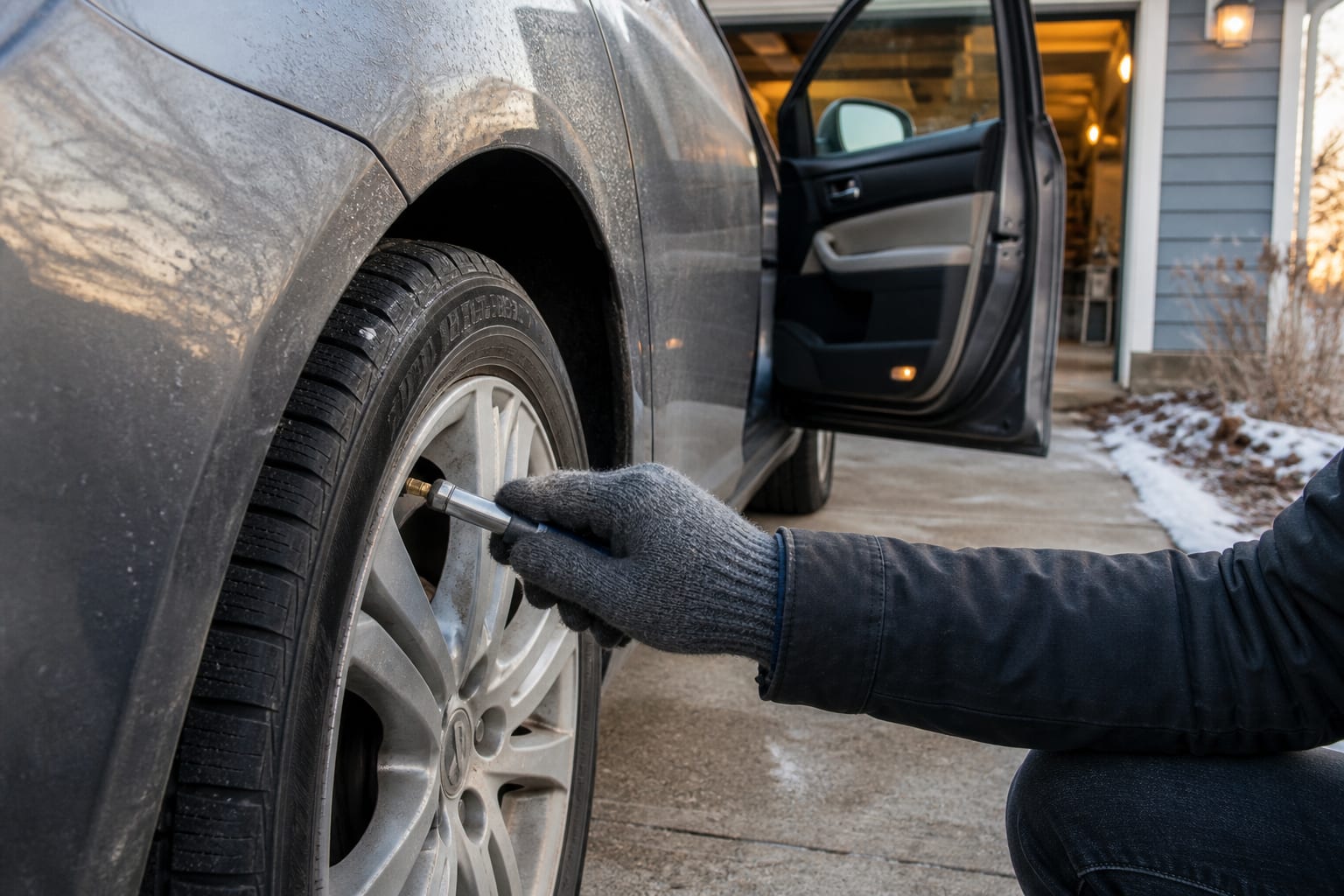
Check every tire—including the spare—at least once a month when the tires are cold. In winter, add a check after a sustained temperature drop of roughly 10°F, before a long trip, heavy load, or towing, and whenever the TPMS warns. The 10°F trigger is a practical reminder based on USTMA’s temperature range, not a federal interval. A hard pothole or curb impact needs a safe initial inspection and pressure check plus professional tire inspection because internal damage may be hidden. Set each tire to the vehicle placard or owner’s-manual value—not the maximum molded into the tire sidewall.
Use a trigger schedule, not a weekly winter myth
NHTSA’s baseline is straightforward: check all tires, including the spare, at least once a month when they are cold. Winter does not create one universal weekly rule. It creates extra triggers. USTMA says passenger-car and light-truck pressure may change by about 1–2 psi for each 10°F change in temperature, so a sustained cold snap can move a correctly set tire away from its placard target before the next calendar check.
Garage Field Notes uses a sustained change of roughly 10°F as a practical reminder to take a new cold reading. That is an editorial decision aid—not a law and not a formula for blindly adding air. Also check before long trips, carrying a heavy load, or towing and whenever the low-pressure warning appears. A hard pothole or curb impact is different: stop safely for an initial inspection and pressure check, then arrange professional tire inspection even if pressure looks normal because impact damage can be internal and initially invisible. If temperatures are stable and none of those events occurs, keep the official monthly check on the calendar.
If columns extend beyond the screen, scroll sideways. Keyboard: focus the table and use the left/right arrow keys.
| Trigger | Why it matters | What to do |
|---|---|---|
| Start of the cold season | Autumn settings may no longer match colder ambient conditions | Record a cold reading for all four road tires and the spare |
| About a 10°F sustained temperature drop | USTMA says pressure may change roughly 1–2 psi per 10°F | Measure; adjust only from the actual cold reading |
| One month since the last check | This is the NHTSA and USTMA minimum routine | Check pressure and visible condition even if TPMS is off |
| Before a long trip, heavy load, or towing | Load, speed, and distance make correct inflation more important | Follow the vehicle’s normal or loaded-pressure instructions |
| TPMS light | At least one tire may already be significantly low | Inspect and measure promptly; follow the vehicle manual |
| Hard pothole or curb impact | Impact damage can be internal even when pressure and appearance seem normal | Stop safely for an initial check, then arrange professional tire inspection |
| One tire repeatedly needs air | Temperature usually affects the set together; one outlier may be leaking | Arrange a tire-service inspection instead of endless top-offs |
‘Cold’ describes the tire, not the weather
A cold-pressure reading is not simply a reading taken outside in winter. NHTSA defines the tire as cold when the vehicle has not been driven for at least three hours. The easiest repeatable method is to measure before the day’s first drive, after the car has sat overnight, using the same accurate gauge each time.
Driving flexes and warms the tire, so the reading normally rises. Do not bleed a recently driven tire down to the placard’s cold value. USTMA warns against reducing hot pressure for that reason. If a tire appears significantly low after driving, NHTSA says adding air to the recommended cold value can be a temporary safer step, but the tire must be measured and adjusted again when a true cold reading is available.
A heated garage creates another condition to think through. A tire can be cold in the no-recent-driving sense while still being much warmer than the outdoor air it will encounter. Do not invent a blanket winter offset. Follow the vehicle manual and, after a large indoor-to-outdoor temperature change, obtain another cold reading once the parked vehicle has equilibrated with the conditions in which it will remain.
Use the temperature rule as a forecast, not an inflation formula
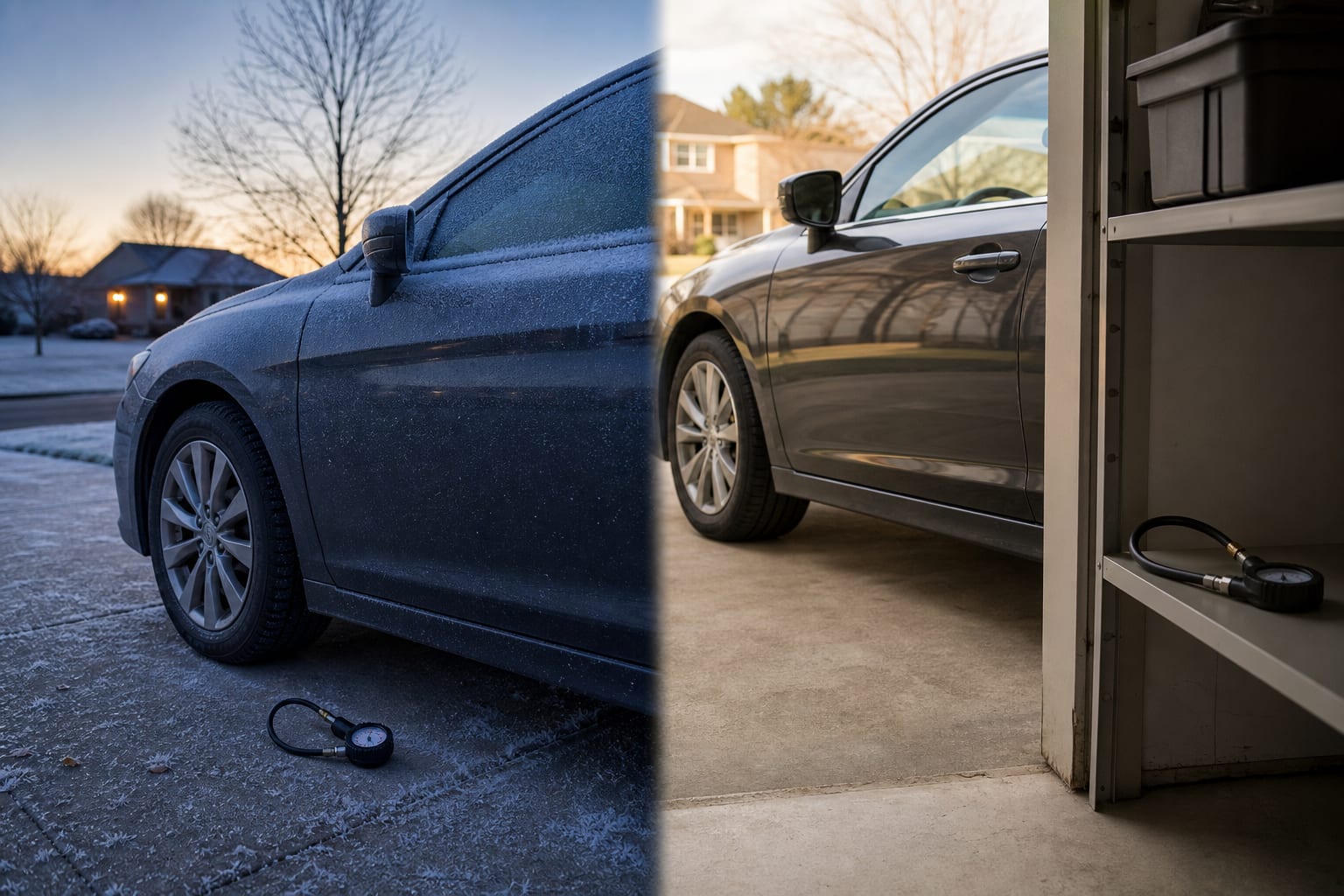
USTMA’s care guide gives a useful range: passenger and light-truck tires may lose 1–2 psi per month under normal conditions and change about 1–2 psi for every 10°F temperature drop. Those numbers explain why a whole set can read lower on the first genuinely cold morning. They do not prove that a specific tire has no leak, and they do not tell you to add a fixed number without measuring.
Example: suppose a vehicle’s placard calls for 35 psi and all four tires measured 35 psi at 50°F. After the car sits through a sustained drop to 30°F, the USTMA range suggests readings could be roughly 2–4 psi lower. The correct response is to measure each tire cold and return it to its 35 psi placard target—not to assume every tire lost exactly the same amount.
Look at the pattern. A similar change across all four tires after a weather shift is consistent with temperature. One tire falling much farther, a repeated loss after adjustment, or a sudden drop after an impact suggests a puncture, valve, rim, bead, or other problem that needs inspection.
If columns extend beyond the screen, scroll sideways. Keyboard: focus the table and use the left/right arrow keys.
| Cold-reading pattern | Reasonable interpretation | Next step |
|---|---|---|
| All four are similarly below target after a cold snap | Temperature is a plausible shared cause | Adjust each to its own placard value and record the readings |
| Only one tire is several psi lower | A localized leak or damage is more likely | Inspect the tread, sidewall, valve, and wheel; seek service if loss continues |
| A tire loses more than 2 psi per month repeatedly | USTMA treats continual loss above that level as needing professional attention | Stop treating repeated inflation as the repair |
| The gauge gives changing results | The seal, valve position, or gauge may be inconsistent | Reseat the gauge squarely and verify with a dependable second gauge or tire shop |
Find the target on the vehicle, not the tire sidewall
Use the Tire and Loading Information label in the driver-side door area or the vehicle owner’s manual. NHTSA is explicit that the correct operating pressure is the vehicle manufacturer’s value, not the number on the tire itself. The sidewall shows a tire limit, not the pressure selected for that vehicle’s weight, handling, and axle loads.
Read the whole label. Front and rear targets can differ. Some vehicles provide a separate loaded condition, and temporary spares often use a very different pressure. Check the spare against the vehicle manual, label, or its specific instructions; do not assume every compact spare uses the same number or that every TPMS monitors it.
If the vehicle has a non-original tire size, winter wheel package, modified load, or a special towing instruction, the stock door label may not answer the whole question. Use the vehicle maker’s approved guidance or a qualified tire professional. Never substitute the sidewall maximum simply because it is visible.
If columns extend beyond the screen, scroll sideways. Keyboard: focus the table and use the left/right arrow keys.
| Condition | Primary source | Important check |
|---|---|---|
| Original-size tires, normal load | Driver-door placard or owner’s manual | Use separate front and rear values if listed |
| Heavy cargo or towing | Vehicle manual or loaded-pressure instruction | Stay within vehicle, axle, tire, and hitch limits |
| Approved winter or replacement size | Vehicle manufacturer guidance or qualified tire professional | Confirm pressure and TPMS procedure for that exact setup |
| Full-size or temporary spare | Vehicle manual, label, or spare-specific marking | Confirm pressure plus any speed and distance limits |
Run one complete five-tire check
Park safely, set the brake, and wait at least three hours. Find the placard first and write down the front, rear, and spare targets before touching a valve. A simple record prevents the common mistake of forcing all four road tires to the same number when the manufacturer specifies different axle pressures.
Work around the car in one direction. Inspect each tire for cuts, bulges, embedded objects, cracked valve components, and unusual wear. Remove the valve cap, press the gauge squarely onto the stem until air no longer hisses, record the result, and repeat once if the seal was poor. Add or release small amounts only from a cold tire, then measure again. Reinstall the valve cap and include the spare before putting the gauge away.
Use the same dependable gauge for trend comparisons. A portable inflator’s display and preset shutoff are convenient, but a separate gauge provides a useful verification. Record the date, outdoor temperature, and readings; a short log makes a repeated one-tire loss much easier to recognize.
- Read the placard and manual before measuring
- Check visual condition as well as pressure
- Measure left front, right front, right rear, left rear, then the spare
- Adjust each position to its specified cold target
- Recheck after adjustment and reinstall every valve cap
- Log the date, temperature, and any tire that needed unusual correction
TPMS is an alarm layer, not a monthly gauge
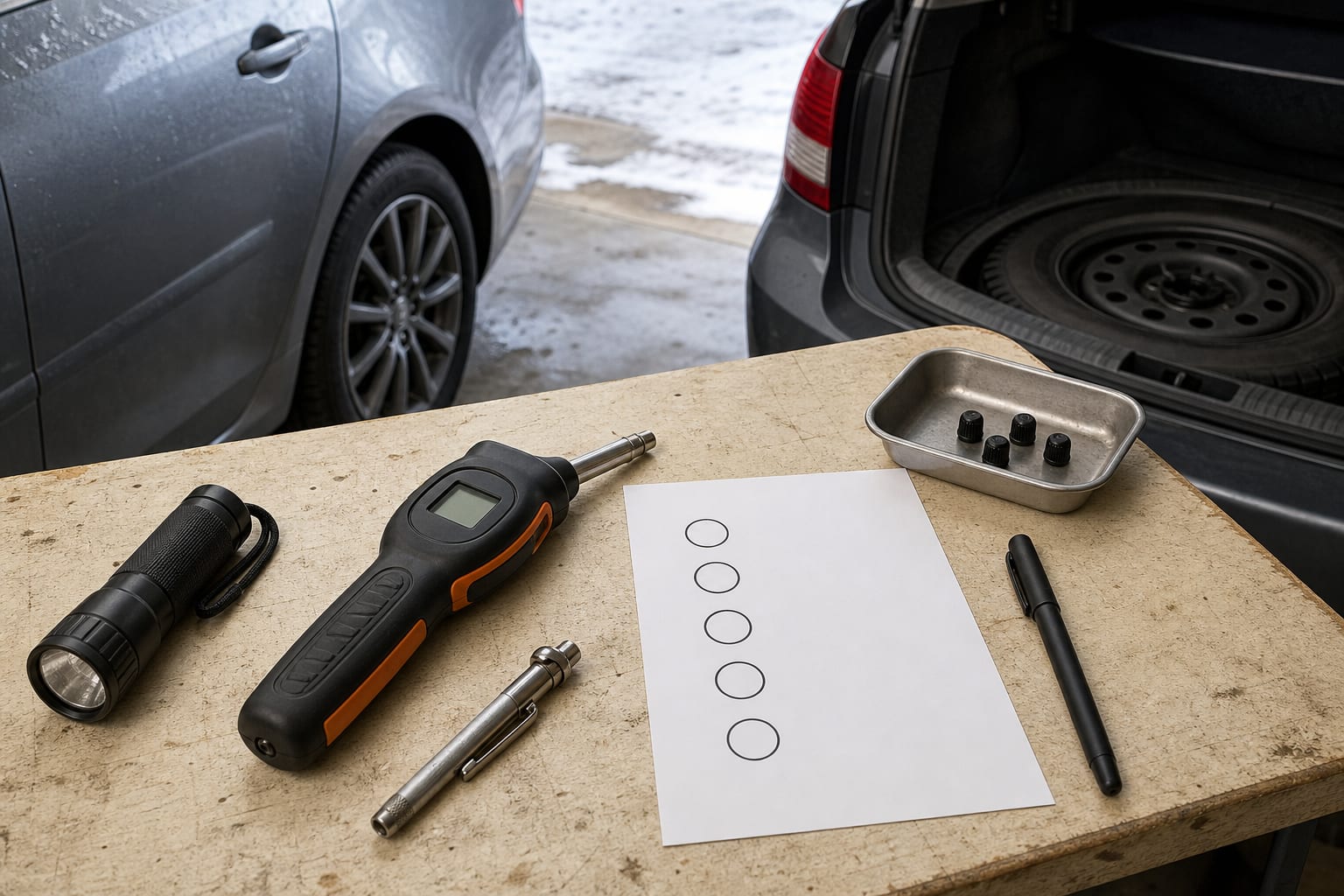
The federal TPMS performance rule is designed around significant underinflation. Under specified test conditions, the warning threshold is generally tied to about 25% below the vehicle maker’s recommended cold pressure, subject to a minimum activation pressure and detection-time requirements. That does not mean every vehicle lights at exactly 25% the instant pressure falls, and it is far below the small correction a routine check may find.
NHTSA notes that a light can appear on a cold morning and turn off as the tire warms. That still calls for inspection and a cold gauge reading. A steady low-pressure symbol means check the tires as soon as safely possible. A symbol that flashes for roughly 60–90 seconds and then stays on indicates a system malfunction on vehicles covered by the federal requirement; follow the owner’s manual and arrange service.
Do not reset or relearn the system merely to extinguish a warning. First set every tire to the correct cold value and follow the vehicle-specific reset procedure. A rapid leak or blowout can also develop faster than the system warns, so steering change, vibration, impact, or visible damage always outranks the absence of a dashboard light.
If columns extend beyond the screen, scroll sideways. Keyboard: focus the table and use the left/right arrow keys.
| What you see | What it does—and does not—mean | Response |
|---|---|---|
| No warning light | Pressure may still be below the optimum placard value | Keep the monthly cold-gauge check |
| Steady low-pressure symbol | At least one tire is significantly low or the system has detected a low condition | Stop in a safe place, inspect, measure, and correct or seek help |
| Light appears cold, then turns off | Warming may have moved a marginal tire above the warning threshold | Check every tire cold; do not dismiss it |
| Light flashes, then remains on | The monitoring system may be malfunctioning | Consult the manual and arrange system inspection |
Avoid the seven winter pressure mistakes
Most winter errors come from using the right fact in the wrong context. The sidewall maximum is real, but it is not the vehicle target. Pressure rises after driving, but that is not permission to bleed a hot tire. Cold weather lowers pressure, but that is not a reason to add a universal winter bonus above the placard.
Use the label, measure cold, and preserve manufacturer exceptions. That approach also avoids assuming all four tires need the same number, forgetting the spare, trusting a visual inspection, or treating the TPMS reset button as a repair.
- Inflating to the tire sidewall maximum instead of the vehicle placard
- Bleeding a hot tire down to the cold target
- Adding a fixed winter PSI amount without taking a reading
- Making front and rear pressures equal when the placard differs
- Ignoring the spare because it is out of sight
- Waiting for TPMS instead of using a gauge monthly
- Repeatedly topping off one tire without finding the leak
Know when inflation stops being the solution
A pressure correction is maintenance; it is not a tire repair. USTMA advises professional attention when a tire continually loses more than 2 psi per month. USTMA also warns that road-hazard impact damage may be internal and initially invisible, so a hard pothole or curb strike merits professional tire inspection even when the first pressure reading and visual check look normal. Seek help sooner for a visible puncture, cut, bulge, cracked or leaking valve, damaged wheel, strong vibration, steering change, audible leak, or pressure that will not hold.
Do not continue normal driving on a visibly flat or damaged tire. Do not crawl under a vehicle, inflate an unsecured tire, or exceed a tire or vehicle limit. If a warning appears while driving, slow smoothly, avoid abrupt maneuvers, and stop in a safe place to inspect and follow the vehicle’s roadside instructions. Roadside assistance is the right tool when the tire cannot be made safe for travel.
The useful winter routine is modest: one monthly cold check, a few event-triggered checks, a written record, and early escalation when the pattern looks wrong. That gives the driver more information than a dashboard light alone without inventing a maintenance schedule the sources do not support.
SOURCES & FURTHER READING
- NHTSA TireWise: monthly cold-pressure checks, placard values, TPMS, and warm-tire cautions↗
- USTMA Tire Care and Safety Guide: temperature range, continual loss, impact damage, spare tires, and TPMS limits↗
- USTMA Tire Care Essentials: monthly, trip, load, towing, and cold-weather checks↗
- NHTSA FMVSS 138 final rule: TPMS activation performance requirements↗
- Toyota 2025 Highlander owner’s manual: a manufacturer-specific cold-reading and inspection example↗
COMMON QUESTIONS
Frequently asked questions
How often should I check tire pressure in winter?+
Check every tire, including the spare, at least once a month when cold. Add a check after a meaningful temperature drop, before a long trip, heavy load, or towing, after a hard pothole impact, and whenever TPMS warns.
How much does tire pressure drop in cold weather?+
USTMA says passenger-car and light-truck pressure may change about 1–2 psi for each 10°F temperature change. Treat that as an approximate planning range; measure the actual cold pressure before adjusting.
Should I add extra PSI above the door sticker in winter?+
Not as a universal rule. Adjust cold tires to the vehicle placard or owner’s-manual value. Use a separate loaded, towing, or approved winter-tire value only when the vehicle manufacturer specifies it.
Is the PSI on the tire sidewall the correct target?+
No. The sidewall value is a tire limit, not the recommended operating pressure for the vehicle. Use the Tire and Loading Information label in the driver-side door area or the owner’s manual.
Why does my TPMS light turn off after I start driving?+
The tire may warm enough to move above the warning threshold. NHTSA says a cold-morning light that later turns off still requires inspection and a cold pressure check.
Do I need to check the spare tire in winter?+
Yes. NHTSA and USTMA include the spare in the monthly check. Use the pressure and limits in the vehicle manual, label, or spare-specific instructions; do not assume every spare uses the same value.

We check guidance against source material, equipment instructions, and our published editorial standards. Read the policy →