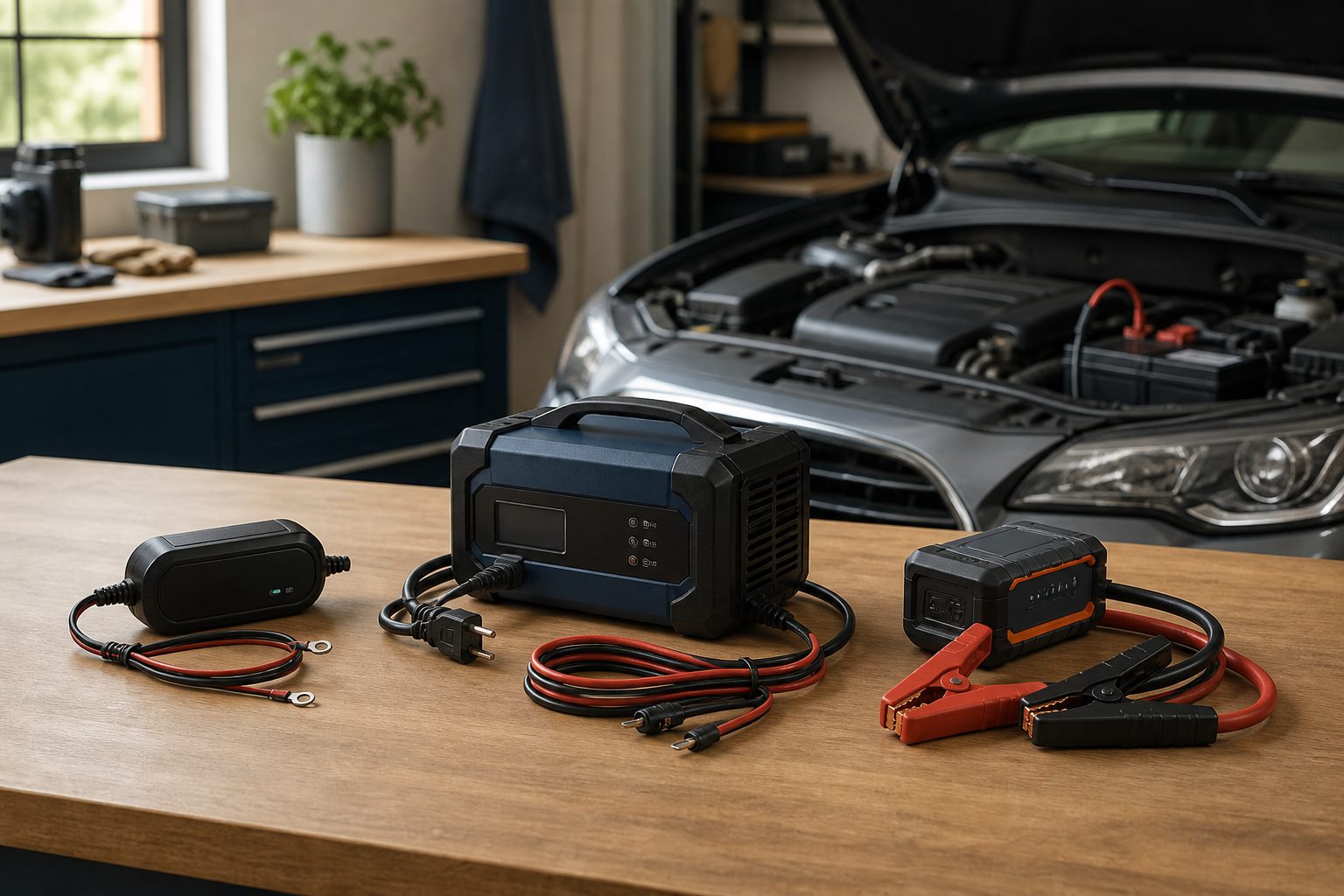
A maintainer keeps a healthy 12-volt battery near full charge during storage. A charger restores energy to a discharged battery over time. A jump starter supplies a brief, high-current boost for starting. Choose only after confirming the vehicle voltage, battery chemistry, approved connection points, and manufacturer instructions.
Three tools solve three different problems
The names are often used interchangeably, but the jobs are not. A battery maintainer monitors voltage and cycles as needed to offset self-discharge during weeks or months of storage. A charger is intended to return a depleted battery to a useful state at a controlled rate. A jump starter is a portable power pack designed to help crank an engine for a short period; it does not fully recharge the vehicle battery.
Start by describing the symptom. A seasonal car that starts normally but sits for six weeks may benefit from a maintainer. A known 12-volt battery that was drained by an interior light may need an appropriate charger and a health check. A no-start away from home may call for roadside assistance or a compatible jump pack. Repeated discharge, swelling, leakage, unusual heat, or a sulfur-like odor calls for professional inspection—not another accessory.
- Maintainer: offsets normal self-discharge during storage
- Charger: replenishes a discharged battery over hours
- Jump starter: provides a brief starting assist
- Battery tester: evaluates condition; it is not a charging tool
Identify the battery and connection procedure first
Read the vehicle owner’s manual and the battery label before shopping. Flooded lead-acid, AGM, EFB, and lithium-based batteries can require different charging profiles and temperature limits. A charger with the wrong mode can undercharge, overcharge, or damage a battery even if the clamps physically fit. Confirm nominal voltage as well; never assume every vehicle or powersports battery uses the same system.
Modern vehicles may specify remote positive and ground points instead of direct battery-terminal access. Some require settings to be preserved or have battery-monitoring sensors in the negative lead. Electric and hybrid vehicles add a crucial distinction: the high-voltage propulsion battery is not a jump-start target. NHTSA advises consulting the owner’s manual; in many models only the low-voltage auxiliary battery can be assisted, using the prescribed procedure.
When a maintainer is the right purchase
A maintainer makes sense for a healthy vehicle that sits long enough for parasitic loads and self-discharge to become a problem. Look for an automatic unit that explicitly supports your battery chemistry and storage environment. The manual should explain connection order, status lights, temperature limits, fault behavior, and whether the unit is approved to remain connected unattended.
Plan the whole installation. The charger body and every connection need a dry, ventilated, stable location away from moving parts and hot exhaust. Route cords where the garage door, hood, tires, people, and pets cannot pinch or pull them. If the vehicle is stored outside, every component and connection must be rated for the conditions; a household extension cord does not turn an indoor maintainer into outdoor equipment.
How to compare chargers and jump starters
For a charger, compatibility and control matter more than the largest amp number. Confirm supported voltage and chemistry, the battery-capacity range, automatic shutoff or maintenance behavior, reverse-polarity protection, and clear fault indicators. A lower charging rate may take longer but can be appropriate for a smaller battery; use the ranges supplied by the battery and charger manufacturers instead of guessing.
For a jump starter, check the vehicle-size guidance, low-temperature limitations, clamp reach, cable flexibility, reverse-polarity protection, recharge interval, and replacement support. Portable power packs age while sitting in a trunk, especially in extreme heat or cold. CPSC’s voluntary-standards information identifies UL 2743 as a relevant standard for portable power packs; certification is one useful filter, not permission to ignore the manual.
- Exact match for voltage and battery chemistry
- Clear connection order and fault indications
- Cables that reach approved vehicle connection points
- Documented storage-temperature and recharge guidance
- Independent safety certification appropriate to the product category
Build a routine, not an emergency surprise
Practice with the vehicle parked safely at home. Locate the approved terminals, read the connection and disconnection sequence, and confirm you can interpret every indicator before darkness or bad weather adds pressure. After use, inspect clamps and cables, allow the unit to cool, and store it so metal objects cannot bridge the contacts.
Put a recurring reminder on your calendar to check the jump pack’s charge and physical condition. For a stored vehicle, periodically inspect the maintainer, cord route, battery area, and garage outlet even if the unit claims automatic operation. If the battery repeatedly needs rescue, have the battery and charging system diagnosed; convenience tools should not hide a developing fault.
SOURCES & FURTHER READING
COMMON QUESTIONS
Frequently asked questions
Can I leave a battery maintainer connected all winter?+
Only if the maintainer and battery manufacturers approve that use and the installation meets their environmental and ventilation instructions. Inspect the setup periodically; automatic does not mean maintenance-free.
Can a jump starter start an electric vehicle?+
Never connect it to an EV’s high-voltage propulsion battery. Some EVs allow assistance to the low-voltage auxiliary battery, but the connection points and procedure are model-specific. Follow the owner’s manual or call roadside assistance.
What size battery charger should I buy?+
Use the battery manufacturer’s recommended charging range, chemistry, capacity, and voltage together with the vehicle manual. The highest amperage is not automatically the best choice.

We check guidance against source material, equipment instructions, and our published editorial standards. Read the policy →