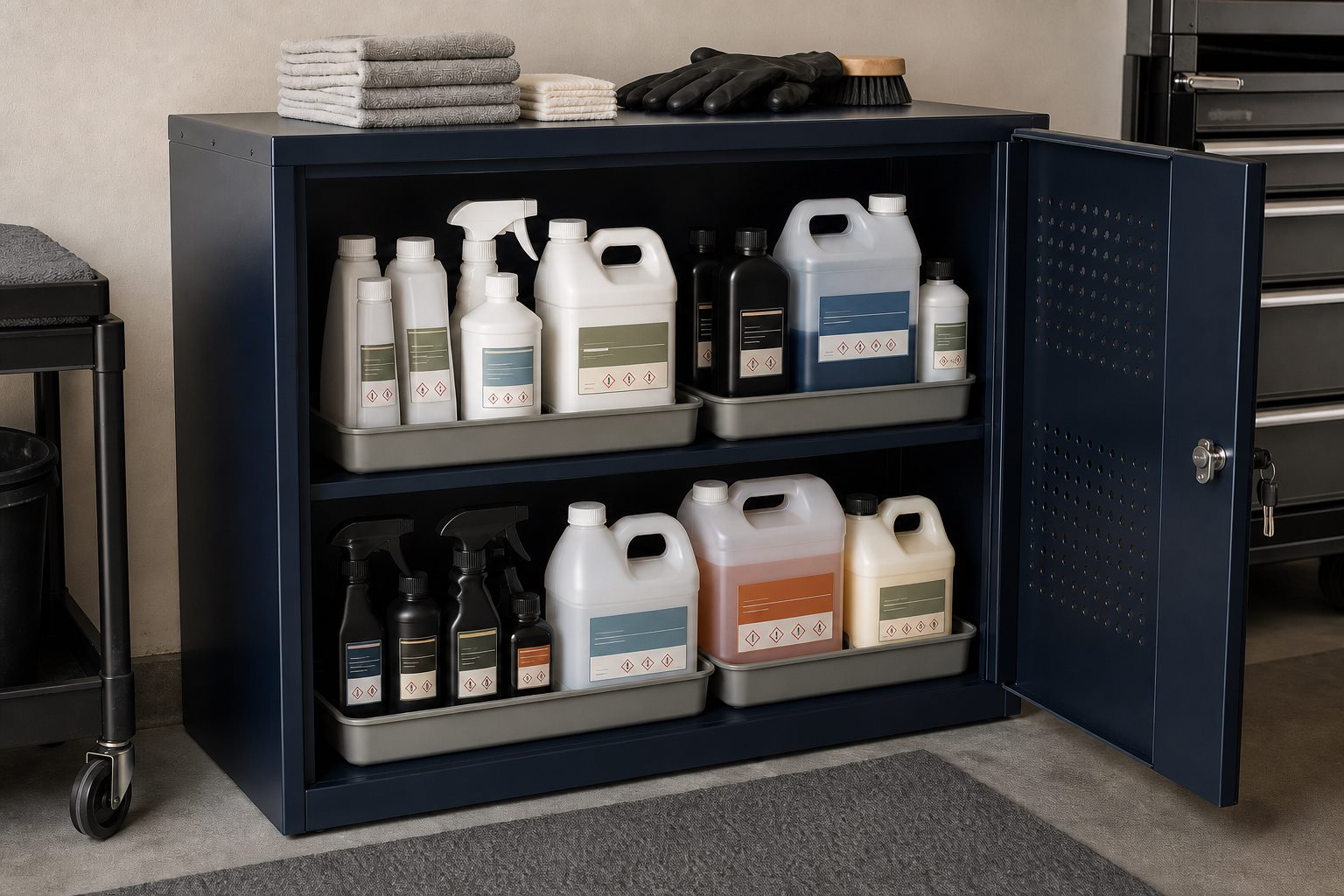
Keep products in their original labeled containers, tightly closed and upright, inside compatible secondary-containment trays. Follow every label’s temperature, ventilation, separation, and ignition-source instructions; keep chemicals away from children, food, drains, and vehicle impact; and use your local household hazardous-waste program for unwanted or unknown products.
Inventory before buying a cabinet
Place every car-care product where you can read it without opening it. Record the product, purpose, purchase date if known, container condition, and storage warnings on the label. Group duplicates and stop buying overlapping chemicals until the oldest usable container is finished. A smaller, understood inventory is easier to store safely than a beautiful cabinet full of mystery bottles.
Set aside anything with a missing label, leaking cap, swollen container, heavy rust, crystallized residue, or an unknown mixture. Do not smell it closely or test it by combining it with another product. Ask the manufacturer or local household hazardous-waste program how to isolate and dispose of it; do not pour it onto the ground, into a storm drain, or down a household drain unless the authority explicitly permits that product and method.
Original containers and labels are the safety system
EPA advises keeping hazardous household products in their original containers and never using food containers. The original package preserves the identity, hazards, first-aid directions, compatibility, lot information, and disposal guidance. Keep the label readable and the cap matched to that container; a familiar-looking clear liquid in a reused bottle is a preventable emergency.
If a product’s instructions allow a temporary working bottle, label it immediately and completely, and never leave the remainder unidentified. Do not store long-term dilutions unless the manufacturer says they remain stable in the chosen container. When an original label is damaged, contact the manufacturer for current documentation rather than inventing a name from memory.
Separate incompatibles and contain leaks
Follow the label or safety data information for separation. Do not place acids, oxidizers, flammable liquids, aerosols, alkaline cleaners, and unknown products together merely because they fit on one shelf. Keep incompatible groups in separate compatible trays so one leaking container cannot reach another. A tray should be chemically suitable, stable, and easy to inspect—not a cardboard box that absorbs and hides a leak.
Store containers upright with caps closed on low, sturdy shelves protected from vehicle doors, tires, falling tools, and garage-door hardware. Heavy jugs belong low enough to lift without reaching overhead, but not where routine flooding or wash water can enter. A locking cabinet can reduce access by children and pets, yet it does not replace ventilation, separation, or an approved flammable-liquid storage solution where one is required.
- Original container with readable label
- Compatible spill tray for each chemical group
- Stable shelf protected from impact
- Child- and pet-resistant access control
- Clear space for inspection and cleanup
Respect temperature, air, and ignition warnings
Garages can freeze in winter and exceed outdoor air temperature in summer. Check each label for storage limits and whether freezing, direct sun, or heat can damage the product or container. Do not move chemicals into living space just to avoid temperature extremes unless the product is specifically approved for that location; choose an allowed climate-controlled storage strategy or reduce the inventory instead.
Keep products away from pilot lights, heaters, sparks, battery charging, welding, grinding, and smoking according to their labels. Aerosol cans and flammable products may have special cabinet, quantity, ventilation, or fire-code requirements. For a large collection or uncertain attached-garage setup, ask the local fire authority or a qualified safety professional rather than assuming a generic metal cabinet is enough.
Run a five-minute monthly inspection
Once a month, check every cap, seam, tray, label, and shelf. Look for odor changes, corrosion, bulging, dampness, residue, expired shelf life, or a product that has separated contrary to its instructions. Correct small organization problems while containers are still sound, and keep absorbent and protective equipment nearby but separate from the chemical trays.
Use your local household hazardous-waste program for products you no longer need and follow its packaging and transport directions. EPA notes that disposal options differ among communities. Keep incompatible wastes separate during transport, secure containers upright in a crate or tub, and never leave them in a hot vehicle longer than necessary.
SOURCES & FURTHER READING
COMMON QUESTIONS
Frequently asked questions
Can car-care products freeze in a garage?+
Some can be damaged by freezing while others tolerate it. Follow the storage-temperature range on each product label; do not assume every cleaner, wax, aerosol, or coating behaves the same way.
Do I need a flammable-liquid storage cabinet?+
It depends on the products, quantities, label instructions, and local fire requirements. An ordinary locking cabinet is not automatically an approved flammable-liquid cabinet. Ask the local authority when uncertain.
Can I transfer chemicals into spray bottles?+
Keep products in original containers whenever possible. If the manufacturer permits a working bottle, use a compatible container, label it immediately and completely, and do not use a food or drink container.

We check guidance against source material, equipment instructions, and our published editorial standards. Read the policy →