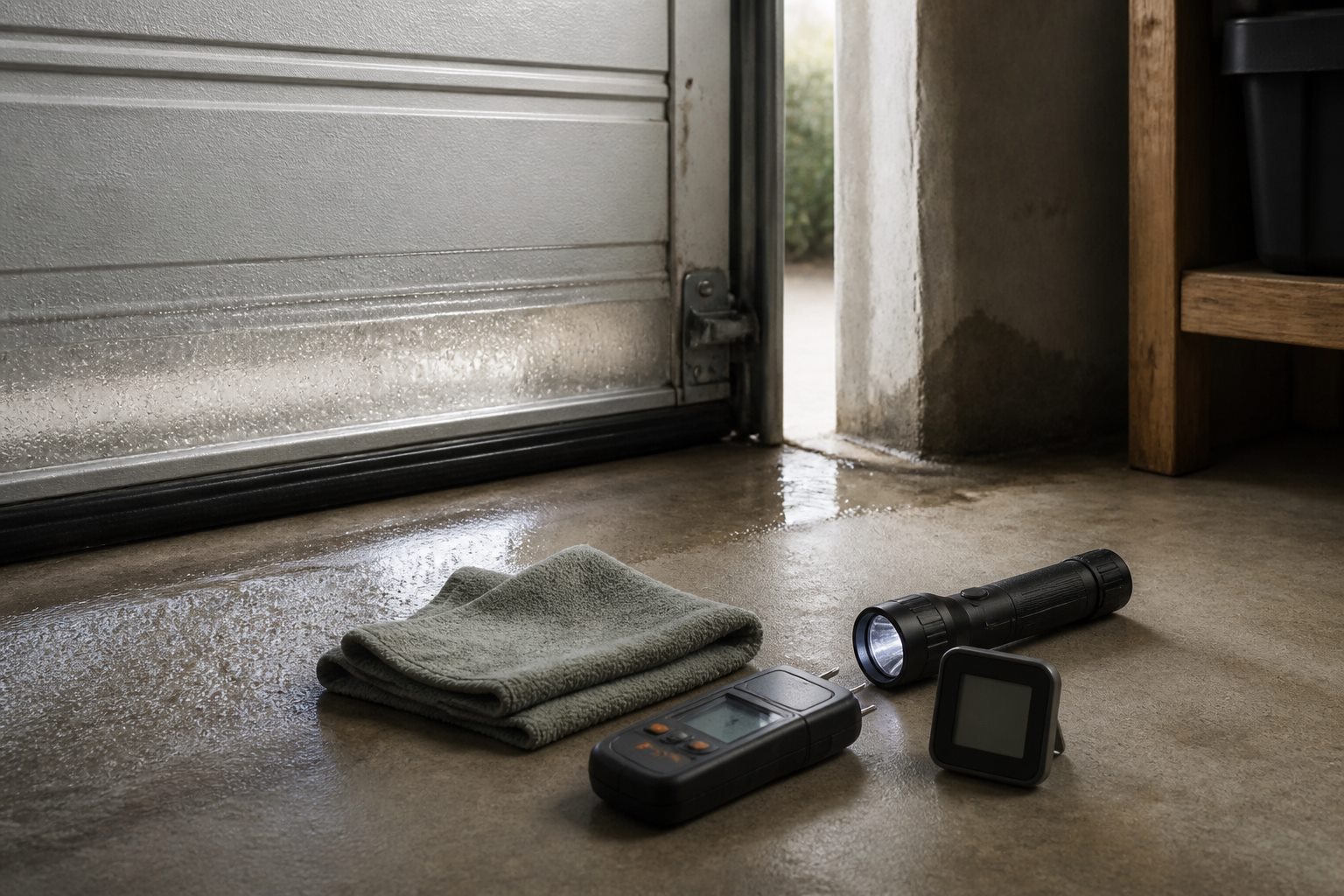
Log garage temperature and relative humidity twice a day for seven days and after rain or a wet vehicle arrives. Fix leaks, drainage, and other bulk-water sources first. Vent only when outdoor air has a lower dew point; if the enclosed garage stays damp after source control, choose a dehumidifier by floor area, moisture condition, and the manufacturer’s operating-temperature range.
Start with a seven-day moisture log
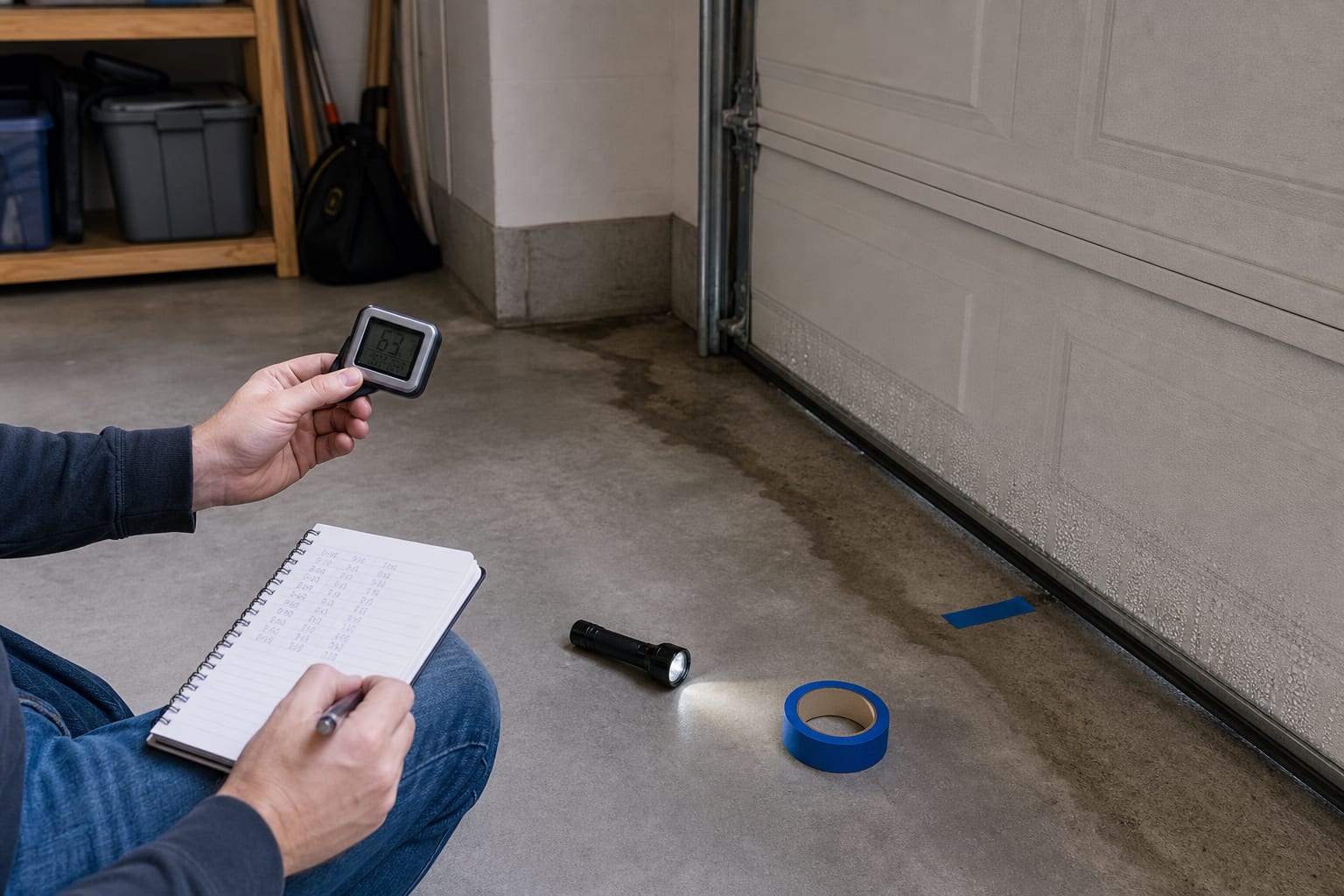
Garage humidity is a symptom, not a diagnosis. Put a reliable digital hygrometer away from direct sun, the door opening, a supply register, and any dehumidifier discharge. Record relative humidity and temperature at roughly the same time each morning and evening for seven days. Add a reading after rain, snowmelt, washing, or parking a wet vehicle, and note whether the overhead door was open.
The U.S. EPA advises keeping indoor relative humidity below 60 percent and ideally between 30 and 50 percent when possible. That is useful moisture-control context, not a universal garage code or a promise that every unconditioned garage must hold 50 percent year-round. A repeated reading, condensation, or a material that stays damp matters more than one isolated number.
- Date, time, garage temperature, and relative humidity
- Outdoor temperature, dew point, and recent rain or snow
- Door-open time and whether a wet vehicle was parked
- Where condensation, odor, staining, or dampness appeared
- Any bucket water or continuous-drain flow from an existing unit
Separate bulk water from airborne humidity
A dehumidifier can remove water vapor; it cannot repair a roof edge, stop water under a door, redirect a downspout, or dry a saturated wall cavity. Inspect during or immediately after the event that raises the reading. Start outside with roof and gutter edges, downspouts, grading, door weather seals, and wall penetrations. Then check slab edges, masonry, plumbing, appliance drains, and the lowest stored cardboard inside.
A wet vehicle is a short, visible moisture load. Remove standing water and wet mats rather than asking a room dehumidifier to evaporate all of it. If the cabin carpet is wet, follow the separate clean-water extraction and layered-drying process in our wet-carpet guide. Keep absorbent boxes and car-care liquids off a damp slab, and use the chemical-storage guide for spill containment rather than mistaking a leaking container for condensation.
If columns extend beyond the screen, scroll sideways. Keyboard: focus the table and use the left/right arrow keys.
| Pattern in the log or inspection | Likely source to check first | First practical action |
|---|---|---|
| Reading jumps after rain; staining follows one wall or door edge | Roof, flashing, gutter, grading, seal, or wall penetration | Trace and repair liquid-water entry before dehumidifying |
| Reading jumps after a wet vehicle arrives, then falls | Snow, rainwater, wet mats, or wet cabin materials | Remove bulk water, dry mats separately, and move dry air across wet layers |
| Condensation appears on one cold door, pipe, or tool | Surface temperature at or below the air’s dew point | Reduce moisture and improve safe air movement or insulation at that surface |
| Garage and outdoor moisture rise together in warm weather | Humid outdoor air entering through an open or leaky enclosure | Close the space for dehumidification; ventilate only when outdoor dew point is lower |
| White mineral deposit or damp line persists at the slab edge | Groundwater, capillary movement, drainage, or a building-envelope defect | Arrange building or drainage diagnosis; do not cover the evidence with storage |
| Musty odor or visible growth remains after drying | Wet porous materials or a concealed moisture source | Stop the source and assess the full affected area before cleaning or enclosing it |
Use dew point to decide when ventilation helps
Relative humidity changes when air temperature changes, so two percentage readings alone can be misleading. The National Weather Service defines dew point as the temperature to which air must cool to reach saturation. When a garage door panel, pipe, slab, or tool surface falls to that temperature, water can condense even if the center of the room looks dry.
For a ventilation decision, compare indoor and outdoor dew point rather than outdoor relative humidity alone. EPA moisture guidance explains that ventilation dehumidifies only when the outdoor dew point is lower than the indoor dew point. A cool, dry day can help carry moisture away; warm humid air entering a cooler garage can add a moisture load and create condensation. Check current weather and air-quality conditions, then use a short supervised ventilation period and watch the next readings instead of assuming an open door is always drying.
Fix sources in the right order
Use the log to rank work by water volume and recurrence. Stop active leaks and drainage first; remove wet porous material or expose it for drying; correct door and wall entry; then reduce uncontrolled humid-air exchange. Only after those steps should a machine manage the residual seasonal vapor load. This order preserves evidence and prevents a dehumidifier from running continuously against an open source.
Storage changes help the diagnosis. Leave a visible inspection strip at exterior walls, keep cardboard and textiles off the slab, and allow air around cabinets instead of packing them tightly against cold masonry. The garage-zoning guide can protect inspection and walking paths, while the shelving guide keeps stored items elevated without guessing at depth or load capacity.
Choose dehumidifier capacity by area and actual condition
Once the garage is enclosed and liquid-water sources are controlled, a portable dehumidifier can manage recurring humid-weather loads. Capacity is rated in U.S. pints removed per 24 hours at specified test conditions. It is not the tank size, and an old machine’s headline capacity may not compare directly with a current model because federal test conditions changed around 2020.
ENERGY STAR sizes portable units from both floor area and the untreated moisture condition. Most one- and two-car garages are below 2,000 square feet, but the smaller-space column is still a range because a dry 500-square-foot garage and a wet 500-square-foot garage do not impose the same load. Use the table as a minimum starting point, then confirm the unit’s rated operating temperature, defrost behavior, clearances, drain options, and instructions. A cold garage may sit outside the product’s approved range even when the pint rating looks generous.
If columns extend beyond the screen, scroll sideways. Keyboard: focus the table and use the left/right arrow keys.
| Untreated condition | Under 2,000 sq. ft. | Over 2,000 sq. ft. |
|---|---|---|
| Slightly to moderately damp: intermittent damp feel or odor, about 50–75% RH | 20–30 pints/day | 30+ pints/day |
| Very damp: consistently damp with spots on walls or floor, about 75–90% RH | 25–40 pints/day | 40+ pints/day |
| Wet: sweating surfaces or seepage, about 90–100% RH | 30–50 pints/day—but diagnose bulk water first | 50+ pints/day—but diagnose bulk water first |
Set up the unit for a fair, safe test
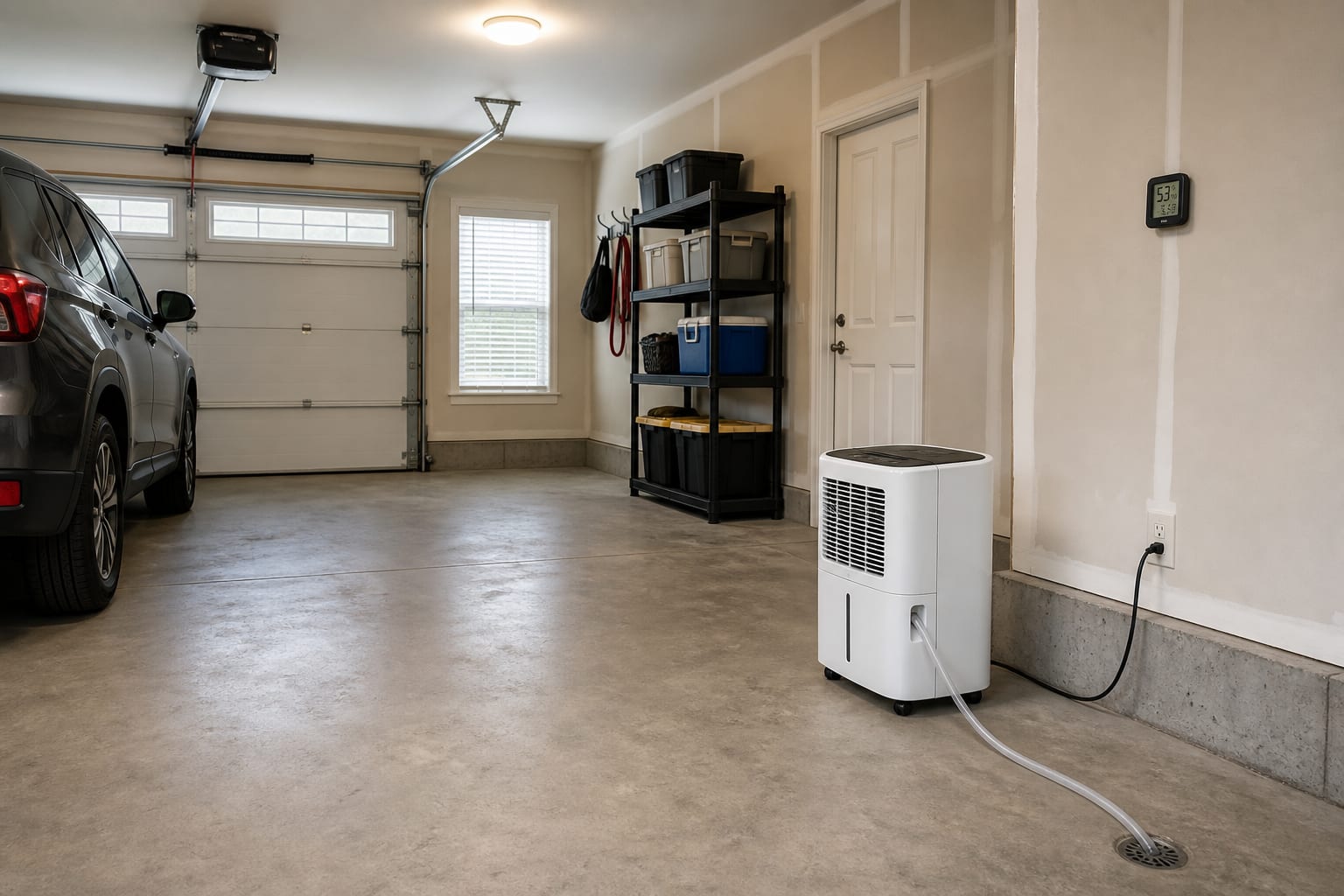
Operate the dehumidifier in the enclosed garage with doors and windows closed. Follow its manual for wall clearance and filter access, keep it away from sanding dust, and plug it directly into a properly grounded receptacle. ENERGY STAR warns against placing drainage near electrical circuits or devices. Route a continuous-drain hose with the slope and lift the manual permits, keep it out of the walking and tire path, and verify that its destination will not create a slip, foundation, or freezing hazard.
Set a reasonable humidistat target, then log readings for at least three representative days. Check that the compressor cycles, the bucket or drain actually collects water, and RH recovers after a wet vehicle arrives. A steady decline followed by cycling suggests the space and unit are working together. No decline, constant operation, frosting, or a dry bucket points to an open source, blocked airflow, unsuitable temperature, bad drainage, a measurement problem, or insufficient capacity—not automatically a defective machine.
- Check the model and serial number against current CPSC dehumidifier recalls
- Use the grounded outlet, cord, and placement required by the manufacturer
- Keep every plug, receptacle, and drain connection away from water
- Close the garage while testing and keep the air path around the unit clear
- Inspect the filter, bucket, and drain instead of assuming unattended flow
Know when the problem is no longer a DIY humidity job
Stop and arrange qualified help for active roof or plumbing leaks, recurring seepage, structural damage, water near energized equipment, fuel or chemical contamination, or moisture inside a wall or ceiling assembly. A garage with fuel-burning equipment, shared mechanical systems, or a proposed permanent exhaust fan also deserves site-specific evaluation rather than an improvised airflow change.
EPA guidance recommends drying wet materials within about 24–48 hours and using professional mold-remediation guidance when the affected area is larger than roughly 10 square feet or the water source is contaminated. Do not diagnose a health risk from color or odor alone, paint over damp material, or run a consumer dehumidifier as a substitute for correcting the source.
SOURCES & FURTHER READING
- U.S. EPA: mold, moisture, humidity, and the 24–48 hour drying window↗
- U.S. EPA: moisture-source control, dew point, ventilation, and dehumidification↗
- National Weather Service: dew point definition↗
- ENERGY STAR: dehumidifier capacity, placement, drainage, and humidity guidance↗
- U.S. CPSC: current dehumidifier recall check↗
COMMON QUESTIONS
Frequently asked questions
What humidity should a garage be?+
EPA recommends keeping indoor RH below 60 percent and ideally between 30 and 50 percent when possible, but that is not a universal garage code. Use it as context while also preventing condensation and following storage, equipment, and building requirements for your climate.
What is the best way to dehumidify a garage?+
Stop leaks and remove bulk water first. Vent only when outdoor dew point is lower than the garage dew point. If an enclosed garage remains seasonally damp, size a dehumidifier by floor area and untreated moisture condition, then verify results with a hygrometer log.
Will opening the garage door reduce humidity?+
Only when incoming air has a lower dew point than the garage air and weather and air quality make ventilation practical. Warm humid air entering a cool garage can add moisture and cause condensation.
What size dehumidifier do I need for a garage?+
For spaces under 2,000 square feet, ENERGY STAR starts at about 20–30 pints per day for slightly to moderately damp conditions, 25–40 for very damp conditions, and 30–50 for wet conditions. Confirm the exact model’s operating-temperature and drainage requirements, and repair seepage before sizing around it.
Can a dehumidifier run in a cold garage?+
Only when the manufacturer rates that model for the garage’s temperature range. Moisture-removal capacity can fall and coils can frost in cold air, so check the manual rather than relying on the pint rating alone.

We check guidance against source material, equipment instructions, and our published editorial standards. Read the policy →