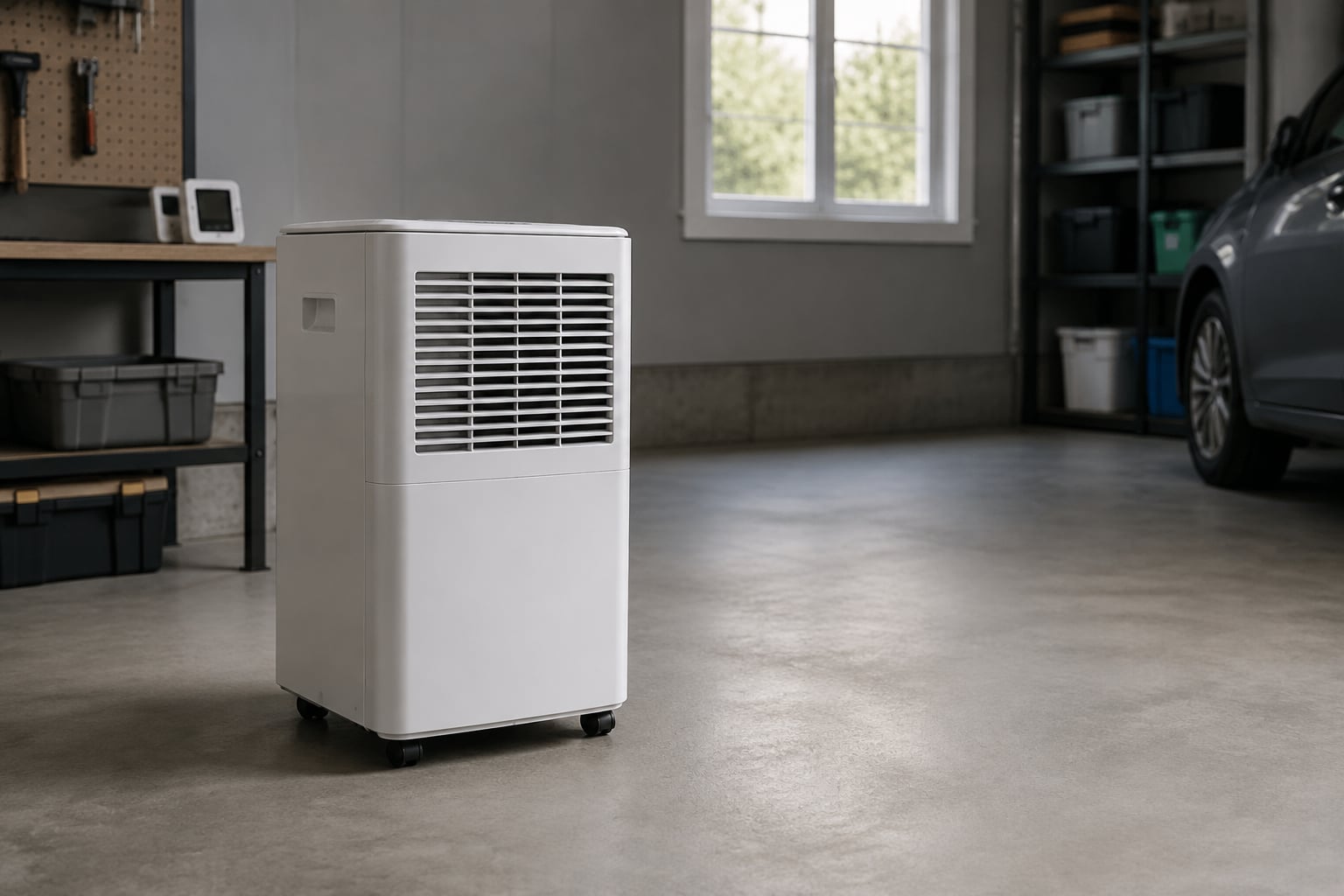
A little frost that clears during the manufacturer’s automatic-defrost cycle can be normal. Persistent ice needs a check of the air temperature at the unit, the exact model’s operating limits, and unobstructed airflow. If the garage falls below that model’s minimum temperature, stop using it there; automatic defrost is not permission to operate outside its rating. Turn off and unplug before owner-approved filter maintenance. Ice that returns despite suitable conditions needs manufacturer support—not scraping, added heat, or a refrigerant repair attempt.
Decide whether you are seeing defrost or a persistent ice problem
This guide covers portable compressor dehumidifiers in enclosed residential garages. It is not a procedure for desiccant units, central HVAC equipment, flooded electrical appliances, or sealed-system repairs. First identify the model and read its defrost and troubleshooting sections. Do not remove the housing to look for ice; use only the observations available through normal owner access.
GE explains that an automatic-defrost cycle may stop the compressor while the fan continues moving air. A fan-only interval therefore does not, by itself, prove a compressor failure. Frigidaire also distinguishes a light coating of frost from heavy buildup that can involve restricted airflow or a system problem. The useful question is whether the frost clears and ordinary moisture collection resumes—not whether the machine sounds different for a few minutes.
If columns extend beyond the screen, scroll sideways. Keyboard: focus the table and use the left/right arrow keys.
| What you observe | What to check | Next action |
|---|---|---|
| Light frost clears; normal operation returns | Defrost behavior described in the model manual | Observe the next cycle without overriding controls |
| Icing mainly overnight or early morning | Lowest air temperature near the inlet | Compare the overnight low with the model’s limit |
| Dusty filter or boxes close to a grille | Owner-accessible filter and required clearance | Switch off, unplug, and perform permitted maintenance |
| Heavy ice persists or quickly returns in suitable conditions | Recorded temperature, airflow checks, and error codes | Stop and contact the manufacturer |
| No water, but no visible frost | Room humidity, setpoint, bucket seating, and drain setup | Use the no-collection checks before diagnosing ice |
| Smoke, burning smell, damaged cord, or water near power | Immediate safety condition, not humidity setting | Stop use; do not restart a hazardous appliance |
Compare the coldest inlet air with the exact operating limit
A warm afternoon reading does not describe an unheated garage at dawn. Place a min/max thermometer or logger near the air inlet without covering it, away from the warmer discharge. Record the low during the hours when icing occurs. Keep the instrument out of direct sun and use its documented accuracy when interpreting a reading close to a limit.
As a specific example, GE’s ADHL-family manual 49-5000545 Rev. 4 directs operation above 41°F (5°C) and no higher than 90°F (32°C). Those are model-family instructions, not universal limits for every dehumidifier. Another model may have a different range. A low-temperature marketing phrase or a large pints-per-day number does not replace the manual.
Illustrative calculation, not a field test: suppose a unit requires air above 41°F and the overnight minimum at its inlet is 38°F. The garage fell 3°F below the threshold, even if it reached 58°F by lunchtime. That supports an unsuitable-temperature explanation before buying parts. Conversely, 42°F on a thermometer with ±2°F specified accuracy does not establish that the inlet stayed above 41°F. Record the uncertainty instead of declaring a one-degree margin sufficient.
Restore owner-serviceable airflow without opening the machine
A clear-looking front does not establish that the inlet, outlet, and filter are clear. Check the manual to locate each one. Look for a storage bin, draped cover, packed dust, or a wall blocking the prescribed air space. Frigidaire’s frost troubleshooting specifically calls for unobstructed airflow and a clean filter.
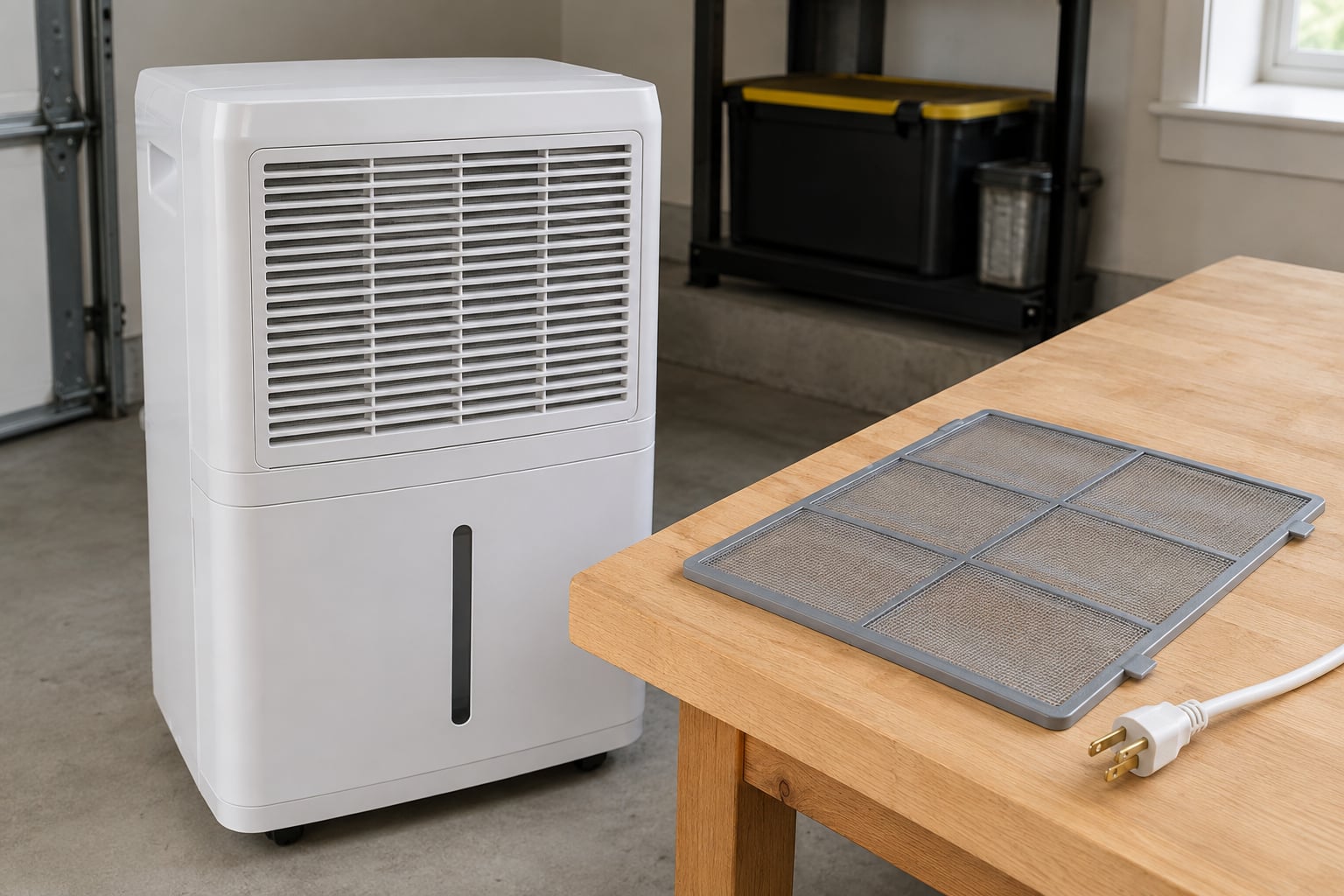
Before cleaning, turn the unit off and unplug it with dry hands from a safely accessible dry location. Remove only the filter intended for owner cleaning. Follow its specified cleaning method, allow a washable filter to dry, and reinstall it before operation. Resetting a filter reminder does not clean a filter. Do not reach into fins or remove panels to clean the coils.
Measure clearance in inches from the appliance to the nearest obstruction, including objects that move when the car is parked. GE’s general placement guidance specifies at least 18 inches on every side; use your own model’s instructions if different. Preserve that space after returning tools or opening a storage cabinet. A blocked passage cannot be corrected by a lower humidity setting.
Let the specified defrost process work—do not force it
When conditions are within the model’s range and the manual describes the observed light frost as normal, follow that manual’s automatic-defrost guidance. Do not repeatedly unplug and restart just to make the compressor run. If the frost does not clear as described, becomes heavy, or keeps returning, stop the machine and ask the manufacturer how to proceed.
Do not scrape or chip ice, use a heat gun or hair dryer, pour hot water into the grille, bypass a sensor, or open refrigerant tubing. The GE manual prohibits unapproved ways of accelerating defrost and warns about flammable refrigerant. An apparent shortcut can damage the appliance or create a hazard.
A larger compressor unit is not automatically the solution to a garage that is below the existing model’s temperature limit. Before replacing anything, compare the garage’s actual seasonal range with the replacement manual. If suitable operation cannot be established, leave the unit off and revisit source control or obtain site-specific equipment advice. Do not run a heater beside it as a makeshift frost treatment.
Rule out no-collection problems that are not icing
An empty bucket is ambiguous: a continuous drain may be carrying water away, the humidity target may already be met, or a full-bucket switch may have stopped collection because the bucket is seated incorrectly. Frigidaire’s no-drying guidance also identifies low temperature and obstructed airflow. Read the mode and indicators before assuming a frozen coil or failed refrigerant circuit.
Separate two observations in your notes: did the appliance collect water, and did the room humidity trend downward? One can occur without the other when wet materials keep adding moisture. Deal with a wet car interior as its own drying task; a garage dehumidifier is not a substitute for extracting accessible clean water or assessing wet padding.
Use a short observation sheet before deciding to retry or replace
The worksheet below is an editorial diagnostic aid, not manufacturer test data. Fill it with your own observations. A photograph of an indicator or visible frost, taken without opening the appliance, can make a support conversation more useful than saying that the garage feels cold. Never keep a hazardous appliance operating just to complete a log.
If columns extend beyond the screen, scroll sideways. Keyboard: focus the table and use the left/right arrow keys.
| Record | Write down | How it changes the decision |
|---|---|---|
| Model and manual | Full model suffix; operating range in °F | Prevents applying another unit’s limits |
| Timing and temperature | Time of icing; inlet minimum/maximum; sensor accuracy | Separates an overnight cold spell from a daytime reading |
| Air path | Measured clearance in inches; filter condition | Identifies a correctable external obstruction |
| Controls and drainage | Mode, RH setting, error code, bucket or drain use | Separates a stop condition from absent demand |
| After permitted correction | Whether frost clears and collection resumes | Normal recovery supports observation; recurring ice calls for support |
Check recalls and keep the service boundary clear
Check the full model and serial number against CPSC’s dehumidifier recall notices and the manufacturer’s recall page. Some recalled dehumidifiers carry familiar brand names; the brand alone neither identifies nor excludes an affected unit. Follow the exact recall remedy and stop-use instruction when there is a match. Do not resell or restart an affected unit to see whether it still works.
Keep the appliance away from combustible materials and flammable vapors. Use the electrical connection its manual requires; the cited GE models prohibit extension cords, surge protectors, and multi-outlet adapters. If the safe position is beyond the supplied cord’s reach, obtain a suitable outlet solution from a qualified electrician instead of improvising a connection.
A recurring ice pattern can have more than one cause. This checklist cannot confirm a refrigerant leak, a sensor fault, or compressor damage. Send the recorded model, temperatures, timing, error codes, and completed owner checks to manufacturer support. Leave disassembly, refrigerant work, and electrical diagnosis to an appropriately qualified service provider.
SOURCES & FURTHER READING
- GE ADHL-family owner’s manual 49-5000545 Rev. 4: model-specific temperature limits and safety instructions (pages 3, 6–10)↗
- GE Appliances: operating conditions, airflow clearance, and model-specific limits↗
- GE Appliances: compressor off and fan running during automatic defrost↗
- Frigidaire: light frost, heavy buildup, filter checks, and when to contact support↗
- Frigidaire: reasons a dehumidifier is not drying the room↗
- U.S. CPSC: dehumidifier recall notices and model identification↗
COMMON QUESTIONS
Frequently asked questions
Is frost on a garage dehumidifier always a fault?+
No. Light frost that clears during the model’s normal defrost cycle can be expected. Persistent heavy ice, repeated icing after permitted checks, or an error code needs the manufacturer’s troubleshooting and support.
Can a dehumidifier freeze up above freezing room temperature?+
Yes. The refrigerated coil can be colder than the surrounding air. Compare the air at the inlet with the model’s operating range; a garage above 32°F is not automatically suitable.
Why does the fan run while the compressor stops?+
On models with the described automatic-defrost design, the fan moves air while the compressor pauses so frost can clear. Other control conditions can also stop the compressor, so check the manual and indicators.
Will turning down the humidity setting fix icing?+
It does not correct an unsuitable air temperature or an obstructed filter. Check the operating range and airflow first rather than asking the unit to run harder.
Can I melt the ice with a hair dryer or scrape it off?+
Do not use unapproved heat, tools, or water to accelerate defrost. Follow the manufacturer’s process and stop for persistent ice; do not open the refrigerant system or bypass its controls.
Should I buy a bigger dehumidifier for a cold garage?+
Not on pint capacity alone. Establish the garage’s coldest operating temperature, compare it with the replacement model’s manual, and address moisture sources first. A bigger unit with the same unsuitable temperature range does not resolve that mismatch.

We check guidance against source material, equipment instructions, and our published editorial standards. Read the policy →