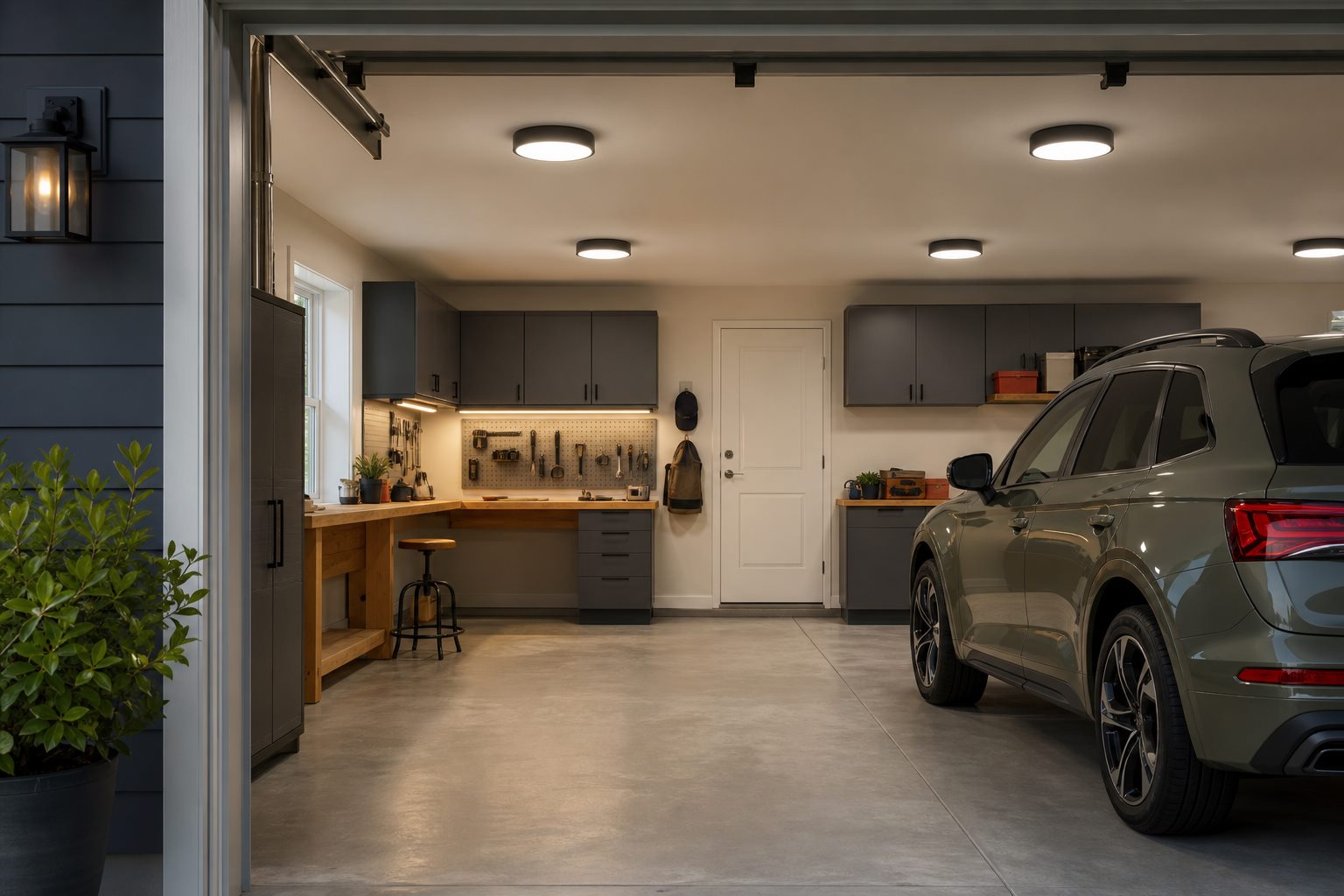
Map parking, walking, storage, and bench tasks first. Compare fixtures by delivered lumens, spread, glare control, color rendering, and location rating—not watts. Use overlapping ambient coverage plus dedicated task lighting, test a small zone, and leave new hardwired circuits or uncertain wiring to a qualified electrician.
Map the garage with the vehicle and door in place
A bright empty room can become shadowy when a vehicle, raised hood, open hatch, shelving, and garage door occupy it. Draw the ceiling and mark parking positions, workbench, utility sink, storage aisles, attic access, opener rails, and door movement. Then list the tasks that need accurate light: finding hardware, checking paint, reading labels, cleaning an interior, or walking to the house.
Take photos at night with the existing lights on. Note dark corners, reflections in glossy paint, and areas where your head or an open hood blocks the beam. These observations determine placement better than copying an online fixture count from a garage with different dimensions and surfaces.
Shop by lumens, not replacement watts
ENERGY STAR explains that lumens measure light output while watts measure energy use. A claim such as ‘replaces a 100-watt bulb’ is a rough comparison, not a layout specification. Compare the fixture’s rated lumens, distribution pattern, efficacy, dimming behavior, and expected output over time.
There is no universal lumen total for every two-car garage. Ceiling height, wall color, fixture optics, work precision, age-related vision needs, and how much shelving absorbs light all change the result. Treat an online calculator as a starting estimate, then test the proposed fixture or a temporary sample before multiplying it across the ceiling.
Layer ambient and task lighting
Use multiple rows or broad-distribution fixtures to create overlapping ambient coverage along both sides of parked vehicles and through the center aisle. Avoid placing every light on one centerline; the roof can block it from doors and lower panels. Keep fixtures clear of garage-door travel, opener hardware, storage lifts, and any service clearance required by the manufacturer.
Add a separate task light above or forward of the workbench so your body does not cast a shadow over the work. A movable inspection light is useful inside a cabin or wheel well, but it should supplement—not replace—safe room lighting. Put task and ambient zones on separate controls when practical so each job uses only the light it needs.
- Overlapping ceiling coverage for walking and parking
- Dedicated, glare-controlled light at the bench
- Portable inspection light for cavities and close work
- Controls positioned where you enter the garage
Choose color and comfort deliberately
Correlated color temperature describes whether white light appears warmer or cooler. Many garages feel comfortable and clear somewhere in the neutral-to-cool range, but preference and task matter more than chasing one number. Mixing dramatically different color temperatures can make the room feel uneven, so keep fixtures in a zone visually consistent unless there is a specific reason not to.
Color rendering affects how accurately paint, wiring, stains, and hardware appear. The U.S. Department of Energy notes that a CRI of 80 is generally the minimum for interior lighting and 90 or higher provides excellent color rendering. Also evaluate flicker, diffusion, and direct view of the LED source; a high-CRI fixture can still be unpleasant if it produces harsh glare.
Upgrade in one tested zone
Start with the darkest or most-used bay. Mount one fixture exactly as proposed, park the vehicle, raise the hood and door, and repeat real tasks at night. Check startup in cold weather, switch compatibility, hum, radio interference, glare at eye level, and whether the product is approved for the garage’s temperature, moisture, ceiling type, and any enclosed fixture.
Plug-in shop lights must use manufacturer-approved mounting and receptacles without creating permanent extension-cord wiring. For new junction boxes, circuits, hardwired dimmers, or any uncertain existing wiring, use a qualified electrician and follow local code. Keep product documentation so replacement fixtures match the electrical and environmental requirements later.
SOURCES & FURTHER READING
COMMON QUESTIONS
Frequently asked questions
How many lumens does a garage need?+
There is no single correct total. Room dimensions, ceiling height, surfaces, fixture distribution, vehicles, and task precision all matter. Estimate, test one zone, and add coverage where measurements and real work show a need.
What color temperature is best for garage lighting?+
Neutral to cooler white is common for task visibility, but comfort, color consistency, and color rendering are more important than one universal Kelvin value. Test the light in the finished room.
Are plug-in LED shop lights safe for permanent use?+
Use only products approved for the mounting method and environment, connected to suitable receptacles exactly as instructed. Do not create permanent wiring with extension cords; ask an electrician when the installation is uncertain.

We check guidance against source material, equipment instructions, and our published editorial standards. Read the policy →