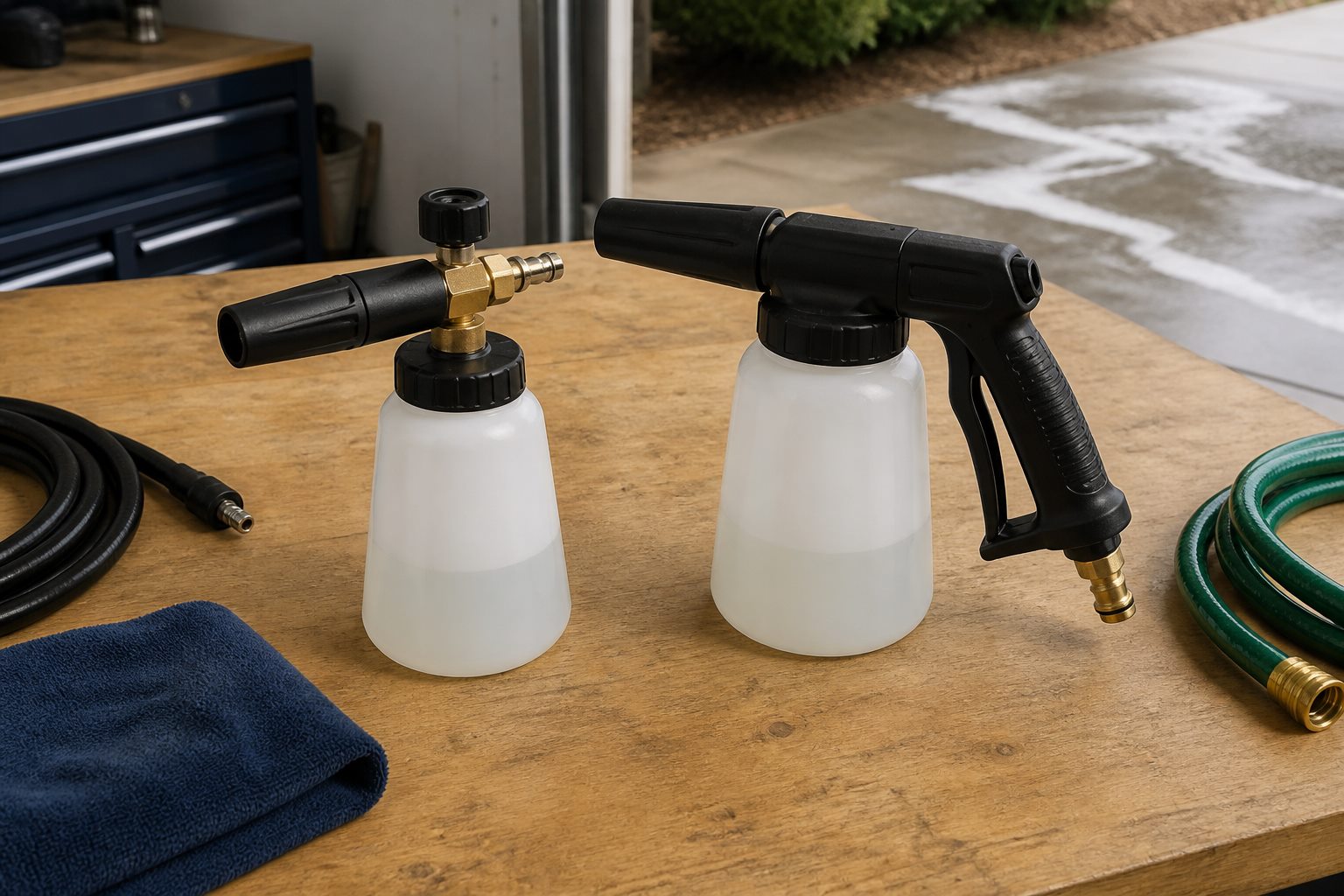
A foam cannon connects to a pressure washer and usually creates denser foam; a foam gun connects to a garden hose and is faster to set up. Choose based on the equipment you already use. Neither replaces safe contact washing on a normally dirty car.
The connection determines the experience
Foam cannons mix detergent with pressurized water downstream of a pressure washer. Foam guns meter soap into ordinary hose flow. The cannon can create thicker foam and greater adjustment, while the gun avoids a motor, power cord, high-pressure hose, and extra fittings.
If you already deploy a pressure washer for every wash, a compatible cannon is a logical accessory. If your normal process begins with a garden hose, adding a pressure washer solely for foam creates more setup than most drivers need.
Foam is coverage, not proof of cleaning
Thick foam can dwell and keep a surface wet, but visual thickness does not guarantee better removal. Chemistry, dwell time, agitation, water hardness, dilution, and the kind of dirt all matter. A dramatic blanket of foam can still leave bonded road film behind.
Use the dilution range on the soap label as the starting point. More concentrate is not automatically better and can waste product or make rinsing harder. Do not let foam dry on the surface.
Choose by your constraint
The cannon is better when you want adjustable output, already own a pressure washer, and have room to manage hose and power. The gun is better when speed, simplicity, and low storage are priorities. A pump sprayer may be better still for pre-treating small areas or for rinseless workflows.
- Existing pressure washer: cannon is the natural fit
- Garden-hose-only setup: foam gun keeps setup simple
- Apartment or water-limited setup: pump sprayer or rinseless pre-spray
- Very light maintenance wash: foam may add little value
Compatibility questions to answer before buying
Identify the pressure-washer fitting, available flow, bottle thread, replacement orifice options, and whether the device remains stable when full. For a foam gun, confirm the hose fitting and whether metering settings are easy to repeat.
A large bottle can reduce refills but becomes top-heavy. Clear volume markings, a wide base, and a pickup tube that reaches the bottom may matter more in daily use than an oversized capacity claim.
Our recommendation
Buy the accessory that fits the process you already enjoy. Do not redesign the entire wash around foam. The best setup is the one you can deploy, rinse, and put away without turning a routine wash into a storage project.
COMMON QUESTIONS
Frequently asked questions
Does a foam cannon clean better than a foam gun?+
It usually produces denser foam, but cleaning depends on the soap, dirt, dwell time, agitation, and rinse—not foam thickness alone.
Can foam replace hand washing?+
On most normally dirty vehicles, foam alone will not remove all bonded road film. Use an appropriate contact-wash method after the pre-wash when needed.
Can I use regular dish soap?+
Use a product intended for automotive surfaces and follow its label. Household detergents may not be designed for vehicle finishes or protectants.

We check guidance against source material, equipment instructions, and our published editorial standards. Read the policy →