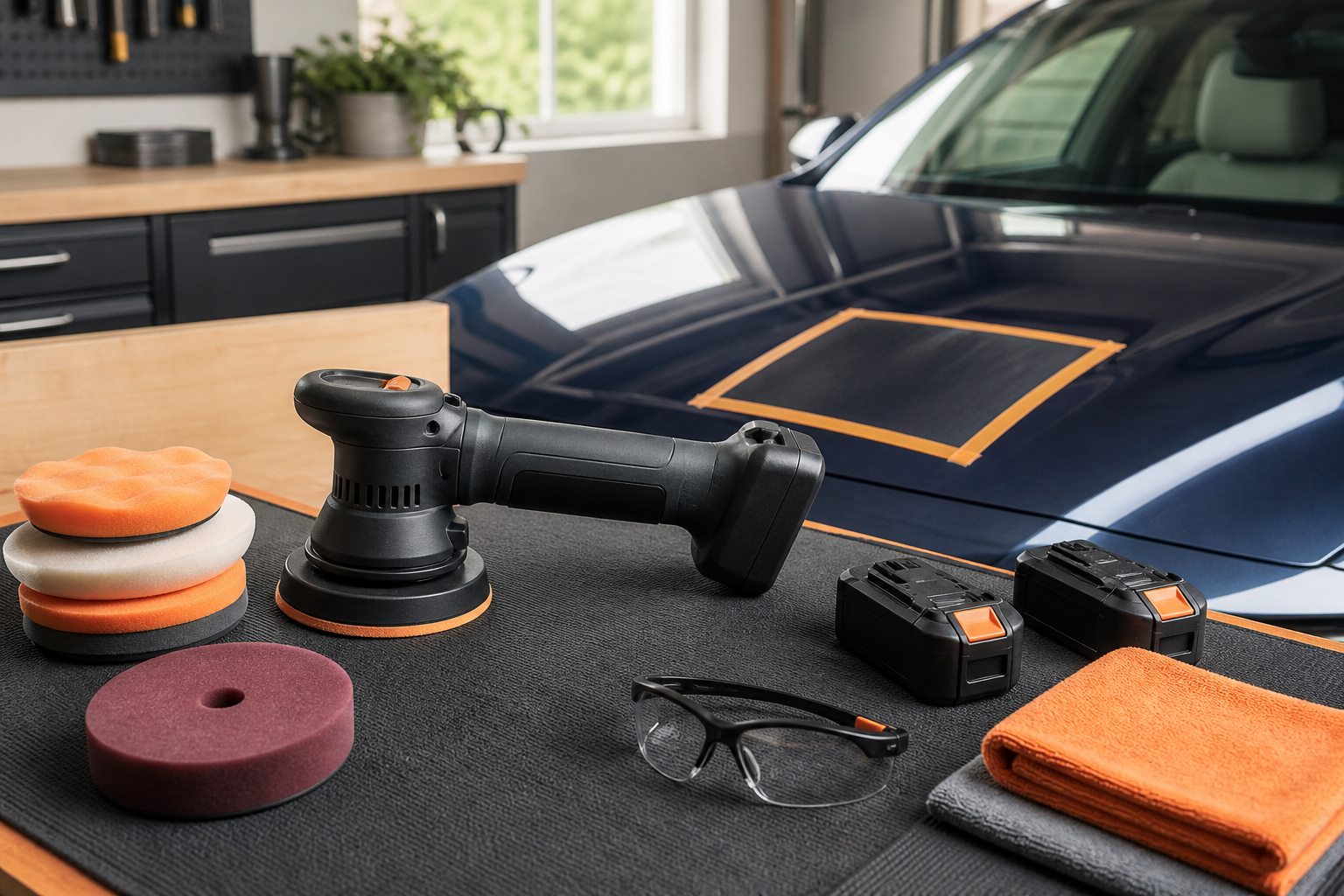
Most beginners should start with a free-spinning dual-action polisher, a mild polish, and a small test area. Cordless models improve mobility but add battery cost, weight, and runtime limits. Learn safe washing and paint inspection before machine correction.
Correction begins before the machine
A polisher cannot compensate for contaminated pads, poor lighting, unknown paint condition, or an aggressive product choice. Wash and decontaminate appropriately, inspect the surface, mask sensitive trim, and begin with the least aggressive pad-and-polish combination likely to work.
If the finish has peeling clear coat, deep damage, body repairs of unknown quality, or very thin paint, professional evaluation may be safer than experimentation.
Why dual action is the usual starting point
A free-spinning dual-action machine combines rotation with an orbit and is generally more forgiving than a direct-drive rotary. It can still damage paint when misused, especially on edges, raised body lines, heat-sensitive areas, or contaminated pads.
Forced-rotation and rotary machines have valid professional uses but require more technique and heat awareness. Beginners benefit more from a predictable mild system and good inspection lighting than from maximum correction speed.
Cordless convenience has a full-system cost
A cordless tool removes the cord from paint and improves movement around a driveway. In return, the battery adds weight, runtime planning, charging, and replacement cost. Compare the entire kit: tool, batteries, charger, pad availability, and the battery platform you already own.
Runtime claims depend on speed, pressure, battery size, temperature, and workload. Plan enough charged capacity to finish a logical section rather than assuming one battery will complete the vehicle.
Pad size changes control
Smaller backing plates improve access on pillars, bumpers, and curved panels but cover less area. Larger pads speed broad panels while becoming awkward near contours. A mainstream size with readily available pads is usually the practical first purchase.
Buy multiple pads. As a pad loads with spent product and removed residue, performance changes and heat can build. Cleaning or swapping pads is part of the process, not an optional upgrade.
A safe first session
Work indoors or in stable shade on cool paint. Use a small test spot, mark the starting condition with clear photos, follow product directions, and inspect after a conservative pass. Stop if behavior, heat, residue, or finish condition is unclear.
- Practice on a known, lower-risk panel if possible
- Start with mild polish and a polishing pad
- Keep the pad flat unless the tool guidance says otherwise
- Avoid lingering on edges and raised lines
- Clean or change pads frequently
- Protect yourself with suitable eye, hearing, and respiratory precautions for the product and work
COMMON QUESTIONS
Frequently asked questions
Are cordless polishers good for beginners?+
They can be, especially free-spinning dual-action models, but battery planning and added weight matter. Technique, inspection, and mild product choice remain essential.
How many batteries do I need?+
It depends on the tool, battery capacity, temperature, speed, and job. Plan enough capacity to finish one section and recharge without rushing.
Can polishing remove deep scratches?+
Polishing mainly refines defects within the upper finish. If a scratch catches a fingernail or exposes a lower layer, aggressive correction may be unsafe or ineffective; seek professional advice.

We check guidance against source material, equipment instructions, and our published editorial standards. Read the policy →