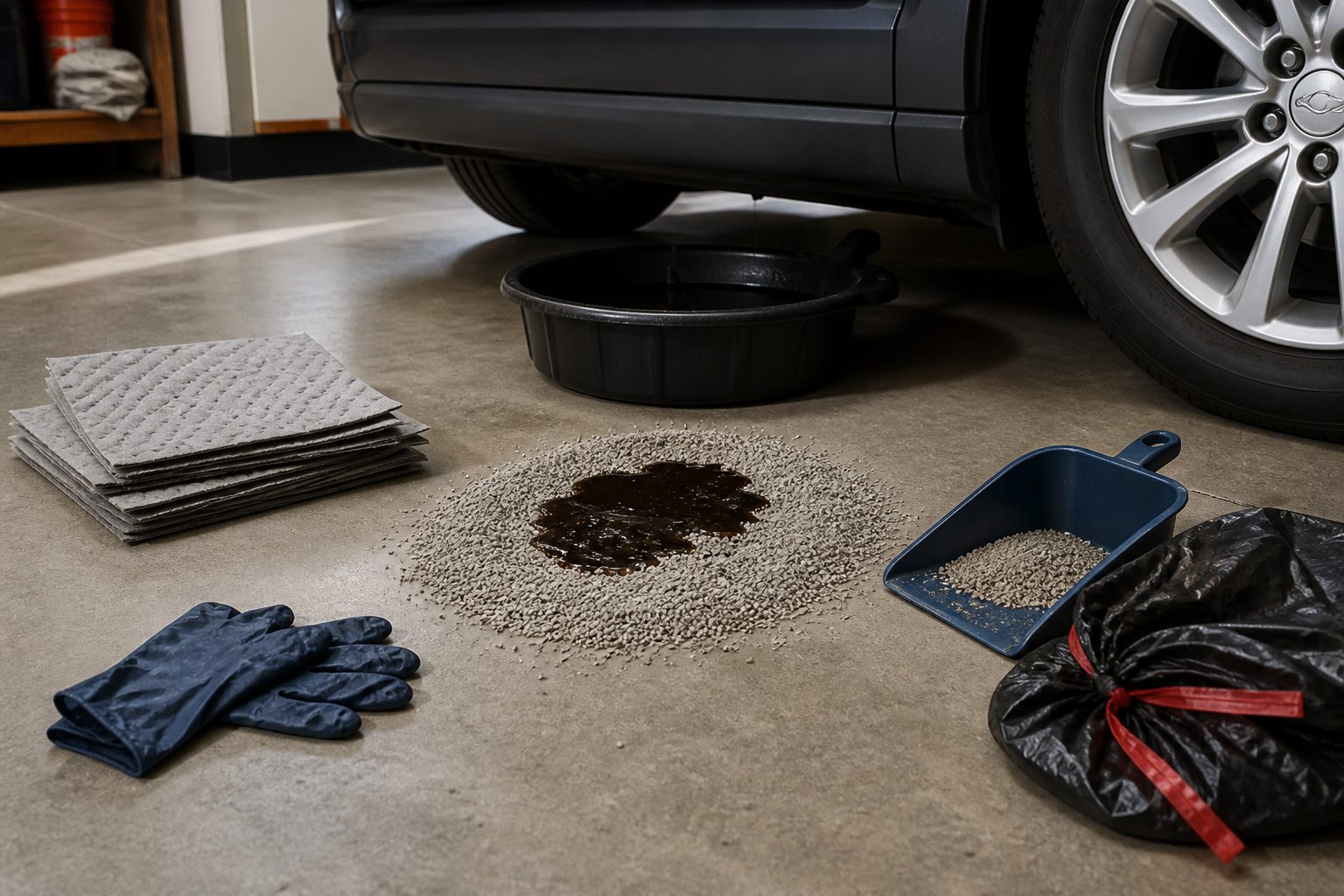
Stop the leak if you can do so safely, keep oil away from drains and the driveway, surround it with compatible absorbent, collect the saturated material, and use only the minimum label-approved cleaner needed for residue. Do not hose the spill outside. Follow local household hazardous-waste instructions for the oil, absorbent, and cleanup materials.
Stop, identify, and size up the spill
Keep people and pets out of the area and remove ignition sources. If the vehicle can be handled safely, switch it off and place a drain pan or compatible tray under the source. Do not crawl under an unsupported vehicle or touch a hot engine. A leaking filter, loose drain plug, damaged pan, or unknown fluid needs repair before cleanup can stay clean.
This method is for a small, known automotive-oil spill you can contain. Leave the area and contact emergency services or the appropriate local authority when the liquid may be fuel, a volatile solvent, a large quantity, actively flowing toward a drain, producing strong fumes, or creating symptoms. Product labels and local agencies take priority over a generic cleanup guide.
Build the perimeter before the center
Protect the nearest floor drain, garage threshold, expansion joint, and downslope route first. Place compatible absorbent socks, pads, or loose granular absorbent around the outer edge, working from clean floor toward the spill. EPA used-oil guidance emphasizes stopping the source, containing the oil, and keeping sorbent materials available for spills.
Do not spray water or cleaner into the puddle. Liquid can spread contamination into concrete pores, under cabinets, across the driveway, or into a storm drain. For a slow active drip, leave a stable drain pan in place while you address the contained floor area, and make sure the pan cannot be kicked or driven over.
Absorb and collect without tracking it
Add the absorbent recommended for petroleum products from the edge toward the center. Allow the dwell time on its label, then use a dedicated dustpan or scraper to collect saturated material into a compatible, closable container or bag as directed locally. Repeat with fresh absorbent until no free liquid remains.
Wear the personal protective equipment specified by the oil and absorbent labels, commonly including suitable gloves and eye protection. Keep clean shoes outside the work zone and avoid kneeling in residue. Used pads, granules, gloves, and wipes can be regulated differently by location, so do not assume they belong in household trash.
- Contain the outside edge first
- Use an absorbent labeled for petroleum liquids
- Work inward and avoid grinding oil into the slab
- Close and label the collected waste for local disposal guidance
Clean the remaining film with minimal liquid
Once free oil is gone, follow the floor-finish and cleaner manufacturers’ instructions for residual staining. Use the smallest practical amount of a compatible degreaser, agitate with a dedicated brush, and capture the resulting liquid with fresh pads or a wet-cleanup method specifically approved for that material. Test coated or sealed concrete in an inconspicuous area first.
Do not combine cleaners, bleach, acids, solvents, or improvised home recipes. Never wash oily water into a street, yard, or storm drain. A cosmetic shadow may remain in porous concrete even after the recoverable oil is removed; repeating aggressive chemistry can damage the slab without improving environmental cleanup.
Dispose locally and prevent the next spill
EPA recommends keeping used oil separate from other wastes and storing it in sound containers that do not leak. Contact your city, county, recycling center, or household hazardous-waste program for current instructions on used oil, saturated absorbent, contaminated rinse liquid, and empty containers. Transport materials upright and secured, following the receiving facility’s rules.
After the vehicle is repaired, place a reusable drip tray under the likely leak point for several days and inspect it. Keep a small spill kit near the garage exit—but above flood level and away from children—with absorbent pads, granules, gloves, eye protection, a scoop, closable waste containers, and local contact information. Early containment turns the next incident into a smaller job.
SOURCES & FURTHER READING
COMMON QUESTIONS
Frequently asked questions
Can I use cat litter to absorb motor oil?+
Some plain clay products absorb oil, but a petroleum-rated spill absorbent provides clearer instructions and performance. Whatever you use, confirm local disposal rules for the saturated material.
Can I pressure-wash an oil stain out of concrete?+
Do not push oil or oily wash water toward a driveway, yard, or storm drain. Recover free oil and cleanup liquid first; follow local wastewater rules and the floor-cleaner instructions.
Where should used oil and absorbent go?+
Requirements vary. Ask your local household hazardous-waste program or used-oil collection site exactly what it accepts and how each material must be packaged.

We check guidance against source material, equipment instructions, and our published editorial standards. Read the policy →